So today I thought I’d try to build an iOS application. Managed to cobble something together over lunch with a lot of copy-paste work going on and no reading of the documentation. Not exactly an ideal way to develop but hey I managed to get a functional application that I wanted. Very rough around the edges but functional nonetheless. I wanted to try it out on actual hardware and realized that I had to sign up for the iPhone Developer Program in order to do so. It costs US$99 a year (~BND$140) but thought I would try give it a go especially since I want to develop an application. So I…
Apple Online Store is unavailable Your country either does not have an Apple Online Store or does not offer Apple Developer Products for Online purchase. To complete the purchase of your program, you will need to complete and fax the Purchase Form below
Grrrrr. Imagine if I did read that 37 page long license agreement only to be greeted with that. I would have been even more infuriated. Couldn’t they have told me that when I entered my country in my personal details? Or if it depends on current location, they could have done that via my IP. Either way they could have just told me upfront that this is not available for me.
As I won’t be able to get the full experience of the app store approval process I did manage to read this iPhone development story which is a good read and does document some annoyances for developers. While I did not manage to get to the point of transferring any Android application to a physical device I am sure it will not be as difficult as this and I believe it is free as well. But kudos to iOS developers and especially Stack Overflow for having resources that I could just copy and paste and get a functioning application all in a matter of hours without reading the documentation. What happened to policy of developers not being able to tell each other how to program for iOS?
So my sister got an iPad and one of the first things I did was to load up my Unofficial Lite Edition of The Brunei Times E-Paper to see how it looked and I was surprised at how bad it rendered the text in the images. It looks fine on my computer and even on a Nokia E71. I wonder why it looked bad on Safari on the iPad. Now if I saved the image and viewed the saved photo in Photos, it turned out fine. Anybody care to explain this to me?
Note: this seems to happen with images that are bigger than the native resolution of the display (or that have to be scaled down in Safari. If I open an smaller image that does not require scaling, the text is fine and clearly visible
Below: Nokia E71 (in Web Browser) and iPad (in Safari) showing the same page (iPad image seems slightly out of focus but close up of the iPad image can be seen in the 2nd photo)
Below: Close up of the page in Safari
Below: As mentioned, if I save the image and open it in Photos it seems fine.
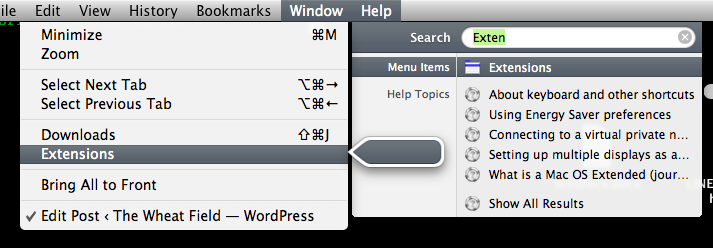
I encountered this cool tip while watching some Mac Break Work. If you can’t remember where to find an exact menu command in program in OS X
Go to the Help Menu
Type word to search for the command. This will populate a list of possible matched commands
Highlight the particular command and click it to execute it or just hover over it and see the ‘magic’. Not only will it open the menu under which the command is listed under but it will also have a little moving pointer that points you to the command
This is great for exploring commands and just finding where a particular command has disappeared to in the menus
Despite there being an option for Windows version of VLC, it seems to be absent in the OS X implementation of it. In order to run multiple instance of VLC on OS X you will have to open up Terminal and run the following command
/Applications/VLC.app/Contents/MacOS/VLC Source
This assumes that you installed VLC into the Applications folder. Otherwise you will have change it to the appropriate path where it is installed. It seems that running multiple instances of a program is discouraged by Apple’s usability guidelines (as mentioned by the forum poster) which would be ironic as I believe QuickTime files in Windows all open in a new window / instance as opposed to using an existing one.
One thing I love about Firefox is the Video DownloadHelper. Not only can it be used to download YouTube videos but it can also detect video in any webpage and offer a download link. This is good for situations where you let a YouTube video load only to find that it has stopped loading half way or something messed up. Also having a copy of the file lets you play it while you’re offline too. One thing that has always got me confused was the download links you get on a YouTube page as shown below
There are 2 .flv links and 2 .mp4 links and each file means something different. If you check YouTube’s wikipedia page there are 6 formats in use and as you can see the a high fmt value (which is the number after “HQ” in the download links above) is not necessarily the best quality and also an .mp4 file link is also not necessary the better quality file.
YouTube file formats
Confusing isn’t it? So I downloaded fmt 34,18 and 35 and the following are screen captures from the video of each of them. I did not download 720p or 1080p as I believe those 2 have the highest quality and the 1080p video link did not display in the listing too.
MP4 (fmt 18), resolution: 480×270:
MP4 (fmt 18) blow up to the same resolution (854×480) for comparison:
FLV (fmt 34), resolution 854×480 (am not sure why the resolution is the same as fmt 35 even though the specifications says it shouldn’t be):
FLV (fmt 35), resolution 854×480:
Based on this video it seems that MP4 makes the video blurry and soft while the FLV files (both format 34 and 35) seem hard to differentiate between. Also take note the file sizes:
MP4 (fmt 18): 14.5MB
FLV (fmt 34): 21.8MB
FLV (fmt 35): 30.1MB
MP4 (fmt 22): 66.8MB
Taking that into account, I recommending downloaded the MP4 if you are more concerned about file size (and data charges if using 3G to download) while stick with FLV 35 for good quality without huge file sizes of a 720p/1080p MP4 high definition video file.
A day after the iPhone 4 was announced with 720p video recording and iMovie for video editing, the Motorola Milestone XT has launched in Singapore with 720p video recording with HDMI out (similar to the Nokia N8) and Nokia also reveals video editing on the N8 (as shown below)
Check out Tech65‘s first look at the Milestone XT below, with pricing with StarHub contracts over at Justin’s blog
I’m personally more interested with Nokia only cause it’s a device with an OS that has yet been released to the public and has features such as USB on-the-go. USB on-the-go allows it to connect to a USB drive for reading and writing purposes just like a regular computer. How cool is that!? Nokia’s timing of releasing footage of movie editing on the N8 has to be a straight punch to iMovie for iPhone 4 and the only issue, specifications wise, for the N8 is the screen resolution of 640×360. Based on Engadget’s smart phone comparison, it’s the 2nd worst of the bunch just after the Palm Pre. However, I still believe in Nokia as it has features like file management via bluetooth, meaning I can transfer files to and from the phone wirelessly. While it may not be as fast as USB, the convenience factor trumps it and I use it all the time with my Nokia E71. Specifications-wise the N8 is similar to the iPhone 4 but being a new OS there could be issues, but I’m hoping that Nokia will use it’s many years of phone making experience to add that extra touch to their new product that could give iOS and Android a run for their money
So I was trying to lay out some icons on the desktop (OS X 10.5.8) and noticed a weird and frustrating issue/problem.
I clicked and dragged an item (using the Trackpad)
Moved it to a location I wanted to place it
I let go of the trackpad
Now we would all think the item would place itself where I had placed it or if auto-arrange is on, to the closest square in the grid. But oddly enough that didn’t happen. If anybody has an answer for me
Check out WWDC live blog coverage by: gdgt | Engadget
Yet again Apple has blown the competition away in several areas with the revelation of the new iPhone 4. Looks (almost?) exactly like the leaked phone and while lots of things were expected there are a few more treats that Apple has thrown in. Firstly the display. Just like the iPad is uses an IPS display which is more power hungry but produces better viewing angles and better colour representation and also like the iPad is uses a resolution that is completely different from the competition. It uses a 960 x 640 display while the maximum resolution I’ve seen on an Android phone is 854×480. I think the reason behind this resolution is that older applications can be scaled exactly 2 times on the screen (old resolution was 480×320) which is easier on the processing and thus better on battery life. Also, this resolution provides the same number of pixels you would find in a typical netbook with 1024×600 screen resolution. This is a great improvement but the only concern is if application developers try to squeeze too much on the screen and make text too small to read.
The camera has HD recording AND editing. Bringing iMovie to the platform is what makes it more of a killer product for those doing in the field recording. You no longer need a laptop to edit videos out in the field. This will aid bloggers at conferences and events a whole lot. The camera finally has a flash and I believe Apple camera will continue to be one of the better ones on the market. Even today the 3GS camera holds it own with the image quality and video capabilities. Tap to focus for video introduced in iOS 4 is another added bonus for video bloggers: no longer do you need a dedicated camcorder. For the ultimate road warrior who always need to be mobile, yet functional this is almost a no brainer. Better to have an iPhone 4 rather than a camcorder and a netbook for video editing. iMovie can export HD video so I would assume that it can edit HD video too. So while you can get a cheap HD camera like the Kodak Zi8 or a Flip Mino HD, the iPhone trumps them in the added functionality and almost matches them on price.
Apple’s A4 processor is found inside and is of no surprised and is one of the contributing factors to the better battery life while still offering great performance. Simple things like an extra microphone for noise canceling is an added bonus just like the 3-axis gyroscope which will be big for games. On the topic of games: 2 huge games Farmville and Guitar Hero are coming and for the general consumer Netflix is coming to the iPhone too. There was also mention of iAd for developers which means of more free applications for consumers with hopefully less obtrusive ads. Better battery life is really icing on the top as many Android phones suffer in that aspect, its a bit of adding salt the the wound of bad battery life that Android has.
Use of micro SIM is a disappointment but expected. While you can hack together one by cutting an existing SIM card there are safer alternatives like Cut My SIM (main site seems down so here’s an article from Gizmodo about it). FaceTime is currently supported on iPhone 4 only as it is a new standard and Steve mentioned that they are going to make it an open standard but only the future will tell what happens. Currently it is not available over 3G/cell network but I’m not sure if this restriction is just to US (probably they are waiting for AT&T to upgrade their infrastructure to handle the extra load) or is something embedded into the application itself.
All in all this is a worthy upgrade to the iPhone line and now Android phone makers need to be pretty worried with the lead Apple has once again in terms of hardware and capability of their new device. Android still has multi-tasking and openness going for it, but is it enough? Multi-tasking on iOS 4 may be multi-tasking done right: it may have it’s limitations but if it gives the general consumer the multi-tasking they need, Android’s multi-tasking feature may just be moot. iPhone 4: Quality hardware on an existing proven platform with good application and developer support
Basically they have 2 phones that should be coming to the market in the coming months (estimated at 4-6 weeks). These phones are the LC203 and the LC303 are have basic features. Both phones are 2G and the LC303 has extra features such as a camera. These 2 phones are not running Android but a custom OS from their partners. They have prototypes that are running Android and Windows Mobile but those phones will only be seen in the future.
Aiming at the B$400-B$600 price point they could make a market for themselves as typical Android handsets are targeting the more premium market at the moment. Looking at QQeStores Android phone listing there is only the Samsung Galaxy Spica I5700 and LG GW620 in this price range. My only concerns would be support for firmware updates to an Android phone. The HTC Hero has yet still get any 2.0+ firmware here in Asia and I wonder if this could be an issue with a new manufacturer. The prototype is running Donut (Android 1.6) but as it is not coming out any time soon, they may be running a newer version of Android so nothing much to comment yet.
Zahid, the managing director of BDFone, informed me that they have partnerships with Alcatel, Motorola and Nokia; and that they are targeting low cost but functional phones. I’m not too sure about lower end feature/dumb phones as I think Nokia has pretty functional phones at the low end but aiming for the lower end of Android may be beneficial. There is a void here as almost all Android phones are trying to be an iPhone killer and fetches top dollar. I’m thinking a non-touch Android phone with a keypad (1-9) would be an interesting form factor like the Nokia E52. Either way I wish them all the best and will try update on any developments on this Brunei phone.
Have you got old/non-working computers? If you do and want a new computer, Concepts has a deal for you.
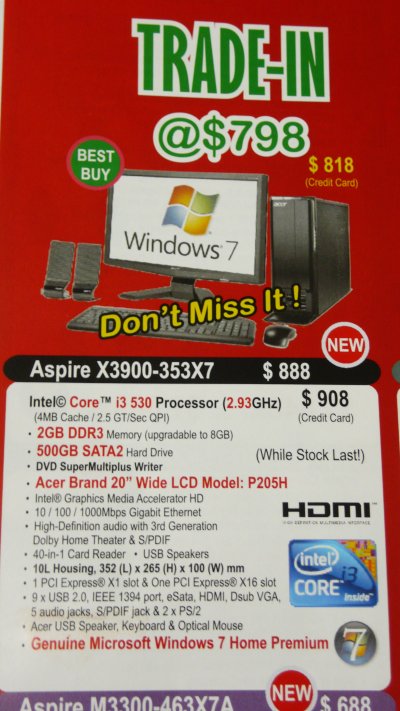
Trade in your old computer at get an Acer Aspire X3900 – 353X7 for B$798 (B$818 with card) which is a B$90 discount for your old computer. The monitor has a resolution of 1600×900 and a standalone cost of B$248 (or B$198 bundled price with a computer) and I believe this is a good deal and the computer is ideal for general / family use.
With only an Intel integrated graphics card, it will not be the perfect gaming machine but there is 1 PCI Express X1 slot and One PCI Express X16 slot (low-profile) for expansion. Note: I was told by the staff that there are no expansions slots, however on the specifications in the brochure and online there seems to be PCI Express slots, so I believe the staff was mistaken. However taking a look at the back of the machine, it is fulled with ports and there doesn’t seem to be any space for expansion cards to be placed. I asked to see inside the chassis but they declined my request. (Update 1: managed to get them to open the chassis for me as there are only 2 SATA connectors which are used for the DVD drive and hard drive and there are 2 expansion slots on the back of the case as shown below, I guess I wasn’t remembering things right) Ports on the back of the system (including 2 slots of PCIe expansion)
Also note that this is a mini-tower and thus regular components may not fit in the expansion slots, thus the reason for "low-profile" mentioned in online specifications of this system. Another thing I noticed is that the configuration that Concepts is selling only has 2GB RAM where all the other bundles I’ve seen for the same model X3900-353X7 has 4GB RAM (Acer Malaysia’s product page | QQeStore | Google Search). I will try clarify with them on this (Update 1: seems that the 2GB is a Brunei deal, other computer shops selling Acer products have the same 2GB with monitor configuration as opposed to 4GB without monitor)
The base Acer Aspire X3900 – 353X7 bundle from QQeStore has 4GB RAM but no monitor. QQeStore sells OCZ 2GB DDR3 RAM for $258 which is more or less the price of the monitor (assuming existing 2GB in the system is a single stick). Personally I have enough monitors at home and would prefer 4GB RAM but I guess for the typical home looking to upgrade a computer system, the choice for a monitor is better. While 4GB would be great for any system, I feel 2GB should be sufficient for most and only enthusiast or people with higher requirements from a computer will complain. (Update 2: You can upgrade RAM to 4GB for B$98 – 2 sticks of 2GB)
Acer Aspire X3900 – 353X7 bundle by Concepts Computers, Brunei
9 x USB 2.0, IEEE 3994 port, eSata, HDMI, Dsub VGA, 5 audio jacks, S/PDIF jack & 2 x PS/2
Acer USB Speaker Keyboard & Optical Mouse
Genuine Microsoft Windows 7 Home Premium
Update 1: Kudo’s to Concepts for allowing me to tickle my fancy of wanting to know how many SATA connectors there are. I asked if I could transplant the system in an existing chassis and they even offered to do it for free. So if you do transplant the system you can use normal sized components but the next issue that you could run into would insufficient power to the component. Stock power supply is only 220W, so if you put in a power hungry graphics card you will have to spend more on an extra power supply too. Possibly add another $200 – $300 for that.
Update 2: So you can upgrade the RAM to 4GB for B$98. (2 sticks of 2GB which is a added nice touch as it means you can max out the RAM without getting rid of any sticks, if they used 4 sticks of 1GB RAM). Also my brother seems to be having an issue with this brand new system. Monitor detected that the video signal was lost, then the power button kept blinking. Tried moving the mouse, pressing the keyboard, pressing the power button and none of that worked. Had to force shutdown and also during a restore, the restoration got stuck.











 The Wheat Field