With the input from the community this survey will help the Prime Minister Office to identify which e-Government services are important to the citizens.
The survey is 28 pages in total and can get pretty time consuming. A compiled version is available here if you want to peruse the questions or even if you want to prepare your answers before answering the real survey.
This is organized by the Prime Minister’s Office, Infocom Federation Brunei in collaboration with E-Government National Centre and BAG Networks. I have to say kudos to the people in charge for taking the initiative for getting the public’s stand and input on something as important is this. I hope other organizations will take an example and try to communicate with the public to understand what is desired. This will help save time and resources of implementing a system only to find out that it is not wanted, thus not used and thus goes to waste.
Participants stand a chance to win prizes such as:
If you are inclined to meet the people in charge and ask further questions there are two more roadshows this coming Tuesday (15th December in Seria) and Sunday (20th December in Temburong)
Have you ever started to download an application and after downloading it you realized that what you downloaded wasn’t the application but a downloader application. I’ve always disliked this as it requires an Internet connection and isn’t an installer that I can just pass around to friends. So this post is dedicated to getting those full installers.
Google Chrome: Download page
Basically add “?standalone=1” to the end of the URL of the download page that shows the Terms of Service
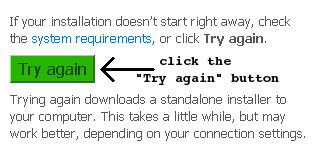
Live Essentials: Download page (On the download page, there is a column on the right with a “Try again” button. On pressing this button you will get the full download)
Just let me say it….. I love Netbooks. Just the convenience factor, price point, battery life and decent performance combined make it a perfect 2nd computer for enthusiasts and a great tool for lower income groups to get started with computers. I believe schools could benefit a great deal from them too thats to the price point. I have always been one for mobile computing and that started off with the whole PDAs of yesteryear (Pocket PCs, Psions and Palms) that has morphed into smartphones of today (too bad I did not try the MessagePad/Newton though I did see it behind the glass display when I visited Labuan). Did you know that the Symbian OS (now Symbian) that is on almost all Nokia smartphones has it’s history in the Psion PDAs? But I digress. Now on to the reason why you should get a Netbook.
Convenience
When compared to regular laptops the sheer convenience is apparent. The first thing to note about a netbook is that it is compact and light. It lets you put it in your bag and not even notice that it is there. That may even be enough for some, who lug around their laptops that they have been using for a year or so and have dismal battery life thus being limited to places where you can use it as you are always looking for a power point to plug in and charge. This brings me to the second great thing about netbooks: the outstanding battery life. The Toshiba NB200 can run for over 9 usable hours! Heck I bet the average netbook would beat out the average laptop on battery life.
More Functional than a Phone
More functional in display size/resolution and due to it having a full operating system. A larger screen with larger resolution lets you surf webpages with ease and provides the full web experience together with Flash. You can also easily enjoy your movies or videos on the large screen without straining your eyes. A full operating system means you won’t be tied down to the limitations of a trimmed down phone operating system and typically with a keyboard you will certainly be able to get more work done more efficiently on a netbook compared to a phone.
Cheap
When I got my first laptop it was over B$3000. Now you can get relatively good laptops for B$1500 but netbooks differentiate themselves by being mostly being under B$1000 (starting from B$600). Within my group of friends that I know have laptops, they end up non-functional after the 3rd year (motherboard failure, graphics failure, mechanical failure i.e. falling apart, etc) which makes me wonder if it really is worth spending all that money just to see it disappear once the device stops working. Most netbooks will be even be cheaper than smartphones that won’t match up to work functionality of a netbook.
Conclusion
Netbooks are great for those mobile warriors that are limited by their phone offerings or the weight of the laptop that requires constant charging when on the go. Netbooks are great for students who need a mobile computer to do their school assignments. The sheer convenience of a netbook must e experienced. I miss my Acer Aspire One as I use my Macbook Pro now: the AA1 was so much more convenient but I had to switch to a proper laptop as the netbook could not keep up with my needs as a heavy power user when I work (for the typical work scenario of Microsoft Office usage and browsing the web it will be more than fine). For other aspects of my AA1 usage, it is still great. Now netbooks are not perfect and you should find out the things you need to know about netbooks before getting one. Also now the lines of netbooks and laptops and sublaptops are blurring with products like the Acer Timeline series that brings laptops to a better standing with good battery life and lighter weight and also with netbooks getting larger (11 and even 12 inch screen). At the end of the day: know what you need, know what the offerings can give you and make the best choice for your needs.
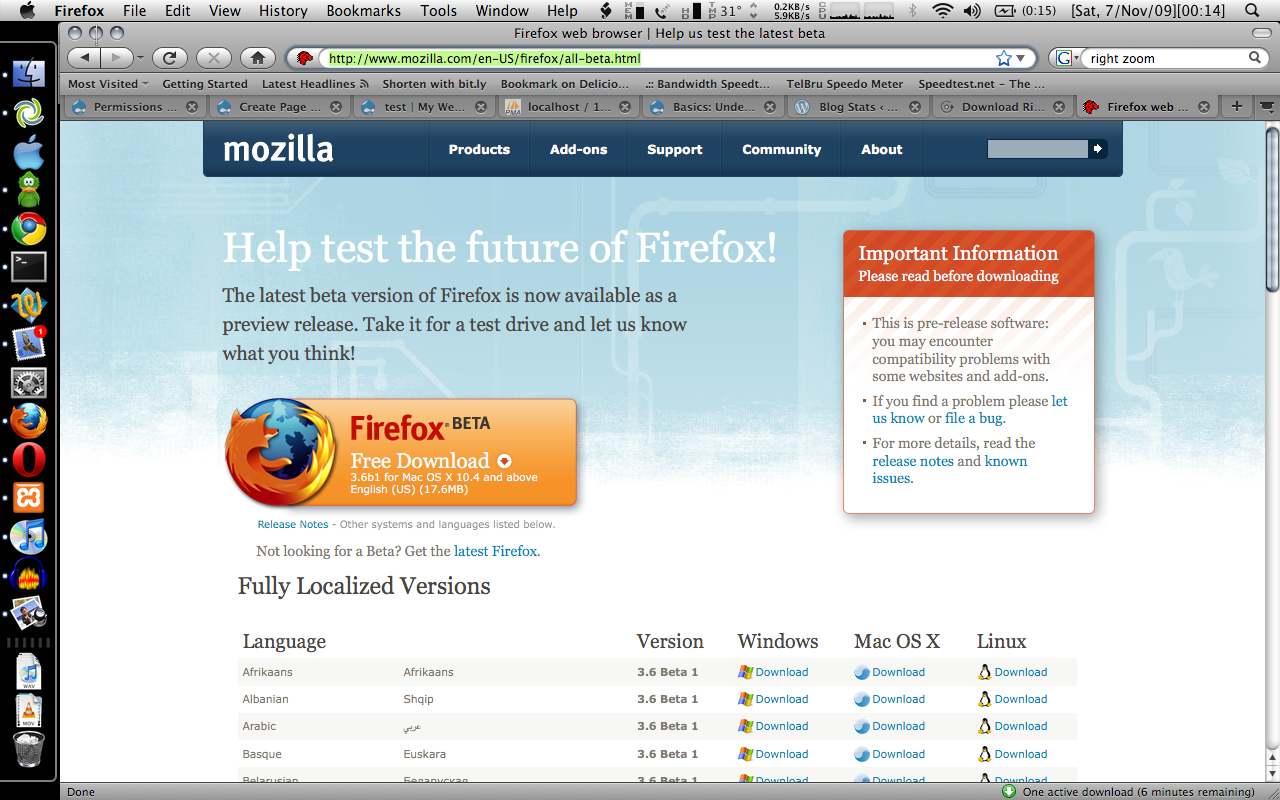
So I downloaded the new Firefox beta and for some reason I couldn’t find the Downloads window when I used the shortcut or selected it from the Window menu item. It took me a while and then I saw it. Look carefully at the image below and you will see the ‘hidden’ download window
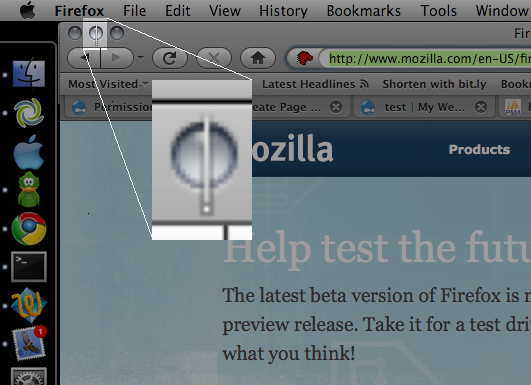
See it yet? No? Well the answer is below:
Now how the heck do I resize something when I can’t even see the buttons nor the bottom right window resizer? I tried clicking/resizing on the window but to no avail. No shortcut is available for OS X to resize or maximize the window (one of my issues with OS X). Thankfully I found Right Zoom that enables me to maximize a window using a keyboard shortcut. Selected the window using Command + ` after Command + Tabbing onto the Firefox icon, pressed Command + Shift + E to maximize and there I found my download window back again! Phew..
Right Zoom was created to change the default behavior of the Zoom button in OS X to make it behave like Window’s and Linux’s Maximize button. It also lets uses assign a customizable keyboard shortcut to maximize the window. As I won’t have my Alt+Space, X as I have in Windows, this is the next best thing. Right Zoom runs in the background and is probably something you want to start automatically when you login (System Preferences > Accounts > Login Items).
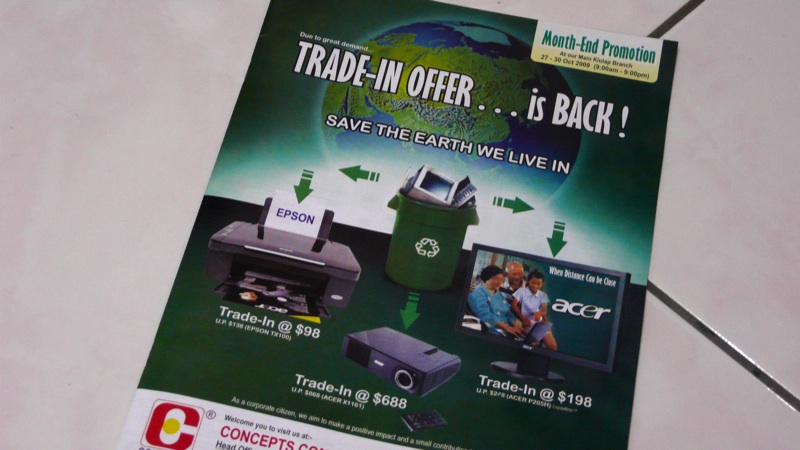
After my post of Concepts Monitor Trade-In where I found out from the owner that they were intending to throw the monitors away, I was pretty happy to see the their ad in the paper that is seen on their handout brochure shown above. “SAVE THE EARTH WE LIVE IN” it says and shows a green bin with a recycling symbol on it. I thought it was great that they are recycling all the monitors and other devices they received from the trade-in offer so I wanted to find out which recycler they were sending the stuff to. So I went to both the Kiulap and Gadong branches to find out more and I was told (at the Gadong branch last Friday) that they were sending it to a recycler in Sungai Akar. However at the Kiulap branch, I was told outrightly today that they were just dumping them and throwing it away. I asked the sales assistant to confirm that they weren’t doing any recycling at all and that they were just throwing them away and she said without hesitation that they were throwing them away.
I was totally appalled! Is the brochure false and/or misleading advertising? I know it doesn’t say that they are recycling the products in black and white but from looking at the ad above how can you not say that they are pushing the message of recycling? Are they just trying to garner public support by supposedly ‘being green’? I personally like that Concepts is differentiating itself from other computer shops in Brunei by organizing seminars, events and promotions but this is severely damaging Concepts’ image in my mind and am personally thinking of even boycotting the company. Now what is the recourse to file a complaint with regards to this false advertising Brunei?
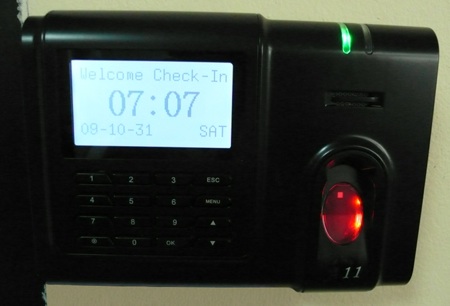
If you bought one of that looks like the picture below, I would say it’s not secure. I have a contact (RFID) card that works for a card reader shown below in a certain organization A. One day I saw the exact same model in a different and totally unrelated organization B. Out of curiosity I tried the card I had and was shocked to find out that it actually worked. So for organizations that are using these type of reader or any off the shelf reader/system do read on to understand how this security issue has arisen.
Biometric Reader / Card Reader:
Biometric Reader / Card Display:
The readers have onboard memory to store information of the cards that it allows access to. It stores “Account No” and the name associated to that account number. The pack of RFID cards supplied with the reader (or bought at a later date) can be programmed with a specific Account Number. A central control software for the reader is used to upload new account numbers to each reader.
After some investigation the data field that was being check to grant or deny access was the “Account No” field. When I put my card on the reader in organization A it displays this Account Number and my name associated to it but when I tried it on organization B’s reader it just showed the Account Number without my name. Data is loaded into the readers via some control software that uploads the data into the reader’s memory storing account numbers and names associated to the account number: this explains the lack of my name in organization B’s reader. Technically this Account Number can be changed but it can only be numbers with a maximum of 5 digits and there can always be a possibility of collisions.
There is no quick fix or sure-fire solution to this security issue with the current implementation if the reader only uses the Account Number for authentication (I do not have access to the hardware to see if there are different and more secure authentication methods available). The reader firmware could be upgraded to recognize the serial number for each card (as each card manufactured should have a unique serial number) and this would prevent collisions and unauthorized access assuming cards have all unique serial numbers. If serial number storage is too memory consuming for the reader, alternatively another piece of information e.g. a passphrase could be used to have 2 factor authentication. The reader can store one copy of this passphrase and use the existing current “Account No” for authentication via 2 different pieces of information. This would make things much harder for collisions and unauthorized access to occur. This is certainly not fool-proof but it makes things much more difficult to gain unauthorized access.
So next time be wary of (cheap) off-the-shelf security solutions, it may not provide the full security you think you’re getting.
Note: The model that was affected was the ZKSoftware A11 however I would think anything that uses the ZKSoftware or has the similar display user interface would be affected.
So there’s a Windows 7 Home Premium Retail Version Promotion for B$168 that Concepts and Netcom seems to be offering. Today is Concepts last day while Netcom is only for order, you can’t pick it up now so you’ll have to wait if you do order. The following is one of these Home Premium retail pack. Notice that it is valid for Distribution and Activation in Southeast Asia only.
Netbooks have been in the market for about 2 years now and I believe they have been a game changer to many. In essence netbooks are smaller, lighter and cheaper compared to notebooks and run on a slower performing processor but get good battery life (4+ hours with some going for 9+ hours). Starting at a cost of ~B$500 they can go all the way up to over B$1,000. Netbooks aim to be a cheap and usable computer for consuming media and as the name suggests to use on the Internet and for cloud computing where you store all your data in the cloud (i.e. the Internet). While it may have started off with smaller solid state drives (SSDs) that didn’t have much drive space, thus forcing users to store they data in the cloud or a USB drive, it is no longer the case and they have regular hard drives similar to notebooks so this is a non-issue.
Processor
Netbooks currently mostly run on Intel Atom processors with some running Via C7 or Via Nano processor and future netbooks are being manufactured to run on ARM. While these processors may not be as fast as a Core 2 Duo or a Corei5, they are sufficient for most tasks but their performance will falter at anything CPU intensive, most notably HD Flash video playback / Photoshop filters / video encoding. For now I would say stick with Atom N Series processors (N280 is more preferable over the N270). The Z series were made specifically for Mobile Internet Devices (MIDs), similar to an iPod Touch, that needs to consume even less power to increase battery life due to their even smaller form factors. Z series Atom processors provide better battery life, but for the typical netbook it hinders performance.
Display
Netbooks typically have 10.1″ displays with a resolution of 1024×600. 1024×600 is a resolution smaller than the 1024×768 which could be considered the ‘lowest’ modern resolution which applications and webpages are designed for. So a typical netbook may have issues with applications that use too much of the screen space: a majority of applications are fine but may need some tweaking to free up more usable screen area by doing things like hiding toolbars. Websites are typically not designed for these smaller resolutions screens and you can find yourself getting frustrated with the small area of actual webpage content that you are able to see. There are ways around this as some netbooks have a feature to set the resolution to 1024×768 or higher but with the panning feature where you place the mouse cursor at the end of the screen and the whole desktop will move in that direction revealing the ‘missing’ resolution.
Screen Panning on a Netbook:
Some netbooks have 1024×576 displays and isn’t much different from the default 1024×600 but with a height of 600 pixels, users will already have screen/desktop real estate issues, and having 24 pixels less height will make this problem even worse. Quite a few netbooks come with the option to have a HD screen with a resolution of 1366×768 making applications and web pages much more usable at the expense of making the text smaller. Text size can be increased at a system level for applications; and for web sites, web pages can be zoomed and there are ways to optimize the browser for netbook use. I have an Acer Aspire One 150B with a 8.9″ screen with a resolution of 1024×600 and indeed the default system text is small thus I would recommend at 10.1″ display for a resolution of 1024×600. I think the Acer Aspire One 751h 11.6″ display with a resolution of 1366×768 is has a great display and resolution combination.
Keyboard
If you’ll be typing quite a fair bit on your netbook you will have to try the keyboard out. Sometimes it is not just the size of the keyboard that matters but the placement of the buttons. Look out for placement and size of the keyboard keys. The tilde (~) key is sometimes placed weirdly and the size of the comma (,), period (.) and slash (/) keys are sometimes made smaller and can be usability issues. On a Dell Vostro 12″ that my church has, which isn’t even a netbook, the comma, period and slash keys are smaller than the other keys and I cannot touch type properly at all. Even my Acer Aspire One 8.9″ has a bigger keyboard with keys of the same size. If you use the cursor keys, check the surrounding keys, some netbooks have “page up” and “page down” keys are on either side of the up arrow key, which leads to accidental presses instead of the left/right arrow keys.
Touchpad/Trackpad
Look for size, button placement and tactile feedback. The Acer Aspire One 8.9″ suffers from a small trackpad and weird button placement: left mouse button on the left of the trackpad and right mouse button on the right of the trackpad. Though it has a nice feature of being able to assign each corner of the trackpad to a different function (I have mapped the lower left corner to be recognized as a right mouse button press) it is just way too small for proper use. It also supports multi-touch pinching for zooming but due to the size of trackpad, the sensitivity from zoom is too high causing me to zoom in/out too much. Netbooks from Asus (I believe from all Eee’s 900 and up) have multi-touch that support even more functions as shown in the video below.
Asus Netbook Multi-touch Functionality:
Being able to press both left and right mouse buttons at the same time is also desirable as pressing them together can be recognized as a middle click, so stay away from those singular buttons that rock left or right for button presses. Good mouse button tactile feedback is desirable as it helps provide physical feedback that the button is pressed enhancing user experience.
Hard drive
Some netbooks give you and option to change out the regular hard disk drive (HDD) for a solid state drive (SSD) which will give you better reliability and performance but as SSD’s are newer technology they cost more and also they cannot store as much data as HDD’s. SSD’s have no physical moving parts thus it is less likely for failure and is resistant to possible drive damage from the mobility of a netbook. With any mobile device, users need to be careful not to make any sudden movements with the device, especially when in operation, as the hard drive head could damage platters that the data is stored on (when not in operation the HDD head should be parked in a safe place). If you choose an HDD, a faster spinning drive will help improve performance thus drives with 5400 RPM or higher would be desirable.
Battery
Some of cheap promotions of netbooks use a 3-cell battery instead of a 6-cell battery. This causes battery-life to be around 2 hours which is fine but if you want true mobility and use of your netbook I believe the added weight of a 6-cell battery is well worth it. Do check out Laptop Magazine’s website for their battery tests on any netbook you are looking at.
VGA Output
If you are planning to use the netbook for presentations a normal VGA output is necessary. Some netbooks have non-VGA outputs but have a dongle / connector to convert it to a VGA output, while it is good it is another thing you would have to remember and not lose. Just keep it simple and get a netbook with a VGA output. You don’t want to arrive at the presentation venue only to find out you misplaced your dongle and end up scrambling to get the presentation on another computer.
Media Playback
If you plan on playing some games and watching HD video, check out netbooks with NVIDIA’s ION chip in it. The HP Mini 311 is equipped with it and even has a HDMI output. While netbooks should typically be able to play most 720p video, NVIDIA ION lets it play 1080p video and games like Call of Duty 4 / Left for Dead / Counter-Strike Source. Game settings will have to be turned down but for light gaming it’s perfect. Note: 720p H264 MP4 files play a bit choppy on my N270 equipped Acer Aspire One, but the 720p WMV videos from Microsoft play fine.
NVIDIA ION showing 1080p media playback:
NVIDIA ION on a Netbook playing Call of Duty 4:
Flash Video
Let it be known that Flash video in HD (e.g. YouTube) by default will not work well on netbooks as Flash utilizes the CPU to process and play the video. A possible workaround to this is to download the Flash video and play it through a media application (e.g. Windows Media Player / Media Player classic) and it would provide smoother playback vs playing in the web browser via Flash. Good codec’s are also necessary to the optimal experience and CoreAVC is recommended for H264 video playback (e.g. YouTube HD video / most video podcasts). Flash version 10.1 (that isn’t released publicly yet) can utilize the graphics card via GPU acceleration and when combined with NVIDIA ION allows smooth Flash video (720p and 1080p) as shown below.
Flash 10.1 playing 720p YouTube HD:
Flash 10.1 playing 1080p YouTube HD:
Operating System
Typical users will stick to Windows and for the sake of performance (especially w/ multi-monitors), I would recommend Windows. Though I do love Linux, the performance of a standard Ubuntu Netbook Remix (UNR) install isn’t as good as Windows XP. Windows 7, although better and faster than Vista, is still slower than XP and performance-wise still edges out UNR.
Other
Bootable SD card slot: having an SD card slot that you can boot directly from is a great feature that lets you try different Linux distros at the change of an SD card and also makes a great recovery method. To make this even more usable, ensure that the SD card will be flush with the device when inserted and not sticking out.
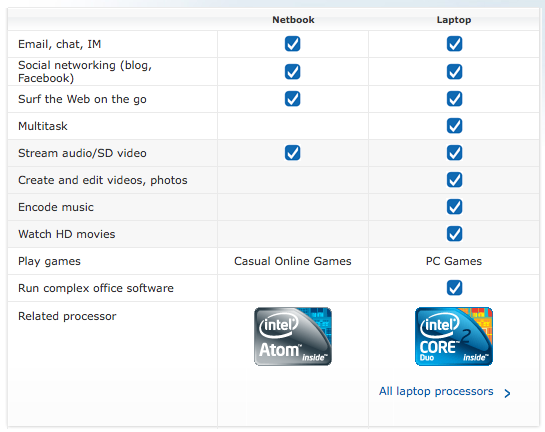
Don’t believe the FUD that Intel is spreading. Technically netbooks can do everything a regular laptop can do, but basically it has a slower processor leading to slower performance. One of the reason Intel could be doing this is to bring up market share of more expensive laptops with the more expensive Core 2 processor from Intel: basically netbooks are cannibalizing the laptop/notebook market and with netbooks having lower profit margins Intel has everything to gain by pushing more people to buy a laptop compared to a netbook.
Take a look at the comments over at JKK Mobile on this same chart. JKK himself says he has edited over 40 videos and all his photos on his Asus Eee PC.
I believe in user education and once users understand that Atom processors are just slower than you ‘average’ processor they should not expect everything out of it. There is no technical reason netbooks cannot multitask, create and edit videos, photos, encode music, watch HD movies or run complex office software as indicated by the absence of ticks in the netbook column. Basically Atom can do all these things just slowly or with conditions. With ION the “Watch HD movies” is out of the question; albeit this comparison was done before ION was generally available but 720p videos could still be viewed before ION thus you could still watch HD movies just not full HD. “Multitasking” is certainly do-able on a netbook and as with any computer / notebook today it depends mostly on the RAM and what types of applications you are running. Video and Photo creation/editing can be done on netbooks, though screen size may hamper it, and the processor may make applying filters/effects/transitions slower but again it can be done. HD video editing would be out of the question but normal VGA (640×480) video that most digital cameras record to should be fine. Encoding music: same thing, can be done but slower, but now with ION video and audio transcoding can be accelerated greatly. For the “Run complex office software” entry I just have to laugh at that, as how complex can office software get? Microsoft Office runs fine on a netbook. Open Office runs fine on a netbook. For most people I don’t think they do any CPU intensive actions on office documents so a netbook is still a good choice.
In Summary
The biggest thing about netbooks has to be their convenience factor: they are small, light and their good battery life makes them even more enticing to bring along with you wherever you go without weighing you down like a regular notebook would. What I love about netbooks is that it makes it even more accessible for people to user computers. No longer are the days that you need at least B$1000 to get a decent computer, these netbooks can cost half of that price and they are getting mobility and usability that hasn’t seen the day of light until now.
So to conclude, the following guidelines should be a great reference when buying a netbook:
Processor: Stick with Atom, preferably N280
Display: Minimum resolution of 1024×600. 1366×768 great for 11″+ screens
Storage: SSD for durability and speed. HDD are fine
RAM: At least 1GB
Battery: 6-cell battery for good battery life
Keyboard: Check for unusual layouts and smaller sized keys
Trackpad: bigger is better, multi-touch a nice bonus, good buttons
NVIDIA ION where possible, if games and HD media playback is important
In all fairness after all my issues with OS X there are still things I like and even love about OS X.
Functional/Usable OS
When I talk about functional I’m comparing it more to Linux. The Windows operating system is pretty much mature to the extent of OS X but in all honesty Linux still has a fair way to go for the desktop market share. I say this as a Linux user for over 3 years now. Any long time (or even regular) Linux user can possibly tell you of issues they have with Linux. Multiple desktops or even getting video out on a projector can still be an issue for Linux users. This can be seen in the opening of the “Linux Sucks” by Bryan Lunduke from the Linux Action Show (now renamed to the Computer Action Show to cover a wider range of topics). MP3, DVD and other codec support has some licensing and legal issues. Installing applications can be an issue too. I have to say I love the way that OS X application installation is done, and I believe BSD is similar to this. For OS X, typically you have an installer (similar to application installing on Windows) or you just drag and drop the application to the “Applications” folder: simple and easy. With Linux there are various ways to install applications depending on your distribution. For Debian based applications you can have .deb files that you double click and it installs similar to installers for Windows, however if there are unmet dependencies the installation will fail. You will have to hunt for the dependency, install that before you can install your application. Now this process is simplified with “apt-get” or variations based on it via the command line or a graphical user interface such as Adept. “apt-get” is great that it brings all software into one searchable index but having a single installer file that requires just a double click to install and ensures the application will work on any single Linux platform is still missing, making it hard to distribute applications on any sneakernet or person to person.
Compared to Linux I believe the “Macs just work” tagline is mostly true, but there is a caveat in that they work according to how Apple wants you to use it. There a issues that I’ve mentioned and just some features you don’t even get. In Snow Leopard‘s enhancements it states that only now you can “Restore deleted items to original folders” and put “Date in menu bar”. Honestly that is pathetic considering Windows has had these features for years. Features that are missing may not be ground breaking but it can be annoying and somehow it feels that you are being forced to use your computer in a certain manner rather than having the freedom of actually using the OS.
More Hardware Compatibility
I compare this solely with Linux as Linux typically gets the least support from hardware manufacturers and I can understand that from a business level: there are not enough users to justify developing a Linux driver and with respect to the packaging problem with different distributions it makes it even more costly to get a general installer. Linux hardware support can be great and it can be bad; there are alot of (older) hardware that will work with current Linux distributions (e.g. Ubuntu) out of the box without the need for manual drivers installation. The same can be true for Windows but sometimes to a lesser degree. While Mac hardware support will never match Windows hardware support it is definitely nice to have manufacturer support for hardware available for the Mac that is not possible with Linux.
Anti-Viral
OS X and Linux really have a great one up over Windows as being more secure in terms of design making viruses practically non-existent. This is to regards to the typical user end viruses and malware (spyware, trojans) that users will get from opening unsafe attachments and visiting malicious websites or just inserting a USB drive in Windows. The lack of viruses is also due to the smaller market share of OS X and Linux compared to Windows. Sad to say that malware production is a business and the people behind them aim for the biggest and easiest targets: Windows users. Now take note that OS X will still not prevent things like phishing that requires user education. Educated Windows users would typically know the risks and take the necessary precautions when using a Windows system.
Great Software Applications
Apple’s iLife is great for the typical user. It makes things easy to do what you get out of them is nice looking: certainly much better looking that any typical Windows or Linux application. For the creative types or people being put in positions to make media content quickly, iMovie and iPhoto enable users to quickly make movies and slideshows without too much effort. GarageBand is great for musicians / podcasters trying to create their own content. iDVD makes burning DVD videos / slideshows simple and the end result looks spiffy. Linux suffers pretty severely in this aspect. Video editing is hard: there is no easy solution thus far that provides functionality similar to Windows Live Movie Maker or the older (some say better) Windows Movie Maker.
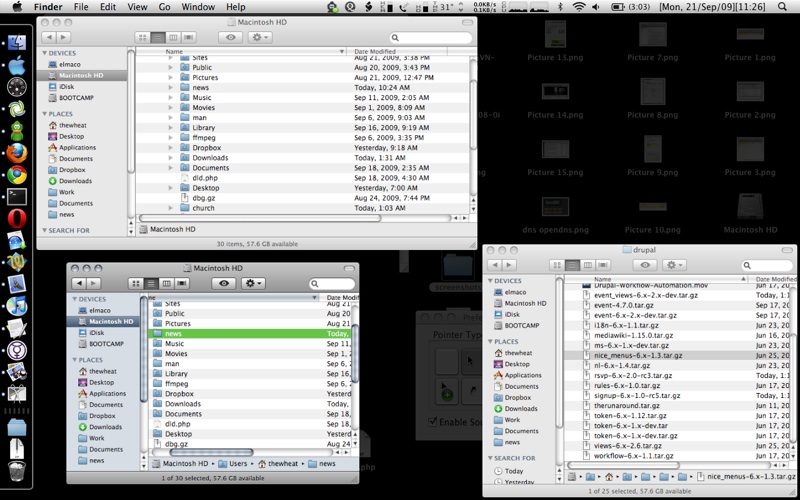
Other great software would be Expose, Spotlight, Quicksilver and Automator. Expose gives a nice looking overview of all windows open at the moment and is something the typical user would use all the time.
Expose in action on 3 Finder windows:
OS X indexing is a great thing as it enables Spotlight and basically OS X’s search to find documents, applications, emails and more quickly and easily. Spotlight is my default application launcher that lets me open applications straight from the keyboard: Command + Space, type in a few letters of the program, Enter > program starts. Need to look for a document or folder? Just type it it and you will see it in spotlight
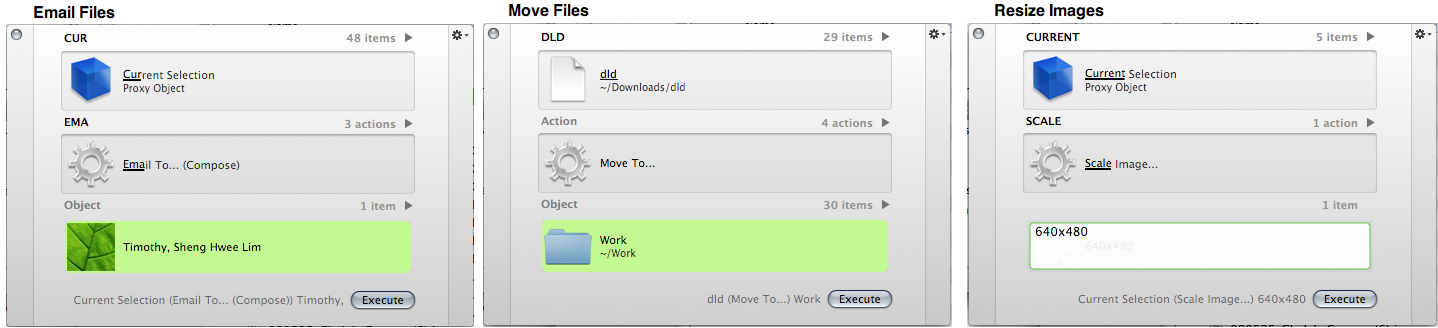
Automator is another great tool for power users and provides greater functionality of the OS so easily through user created Automator actions and if you can’t find an Automator action that does the task you want, you can create it easily through a simple graphical user interface. Resize all photos in a directory and save them elsewhere? Check. Renaming a bunch of files in a directory? Check. Categorize downloaded files into folders and add downloaded music to iTunes library? Check. Just like Quicksilver the applications are practically limitless. (Learn more: Getting Started with the Mac OS X Automator)
Multi-touch
Supporting multi-touch and having a multi-touch enabled trackpad is wonderful: it brings simplicity and functionality together with intuitiveness. Multi-touch is in many notebook trackpads but one of the earliest real uses of it, similar to OS X’s, is in the Asus EEE 900 netbook. Multi-touch trackpads are one of those things that once you have, it’s hard to go back to life without it.
Conclusion
OS X is a great platform. If viruses and malware don’t chase you away from Windows, the “things just work” (and work nicely) scenario just may bring you over to OS X. That being said, OS X technically requires a Mac computer which is something, myself included, dislike. This is where OSx86 Project, Hackint0sh.org and Hackintosh.com come in: they document hardware that is compatible with OS X and provide ways to install OS X on your regular PC without the need to buy Apple hardware. This is a legal gray/black area and may not get you a fully working version of OS X (I’ve heard EFiX provides a fully working OS X installation, including software updates, not sure about any other routes). All this hacking to get OX to run on a regular PC just shows how much people want to use OS X but just not on the limited/expensive hardware Apple offers. I guess it shows how much some people just love the OS.
Windows: provides the most compatibility with applications and hardware with the expense of having to know how to use the system carefully due to malware. (on a personal note, Windows is the most productive OS)
Linux: offers a sense of freedom that cannot be matched: free (as in beer and speech) applications that provide a completely non-restrictive environment with great stability but lacking in hardware manufacturer support and software areas (e.g. video editing). The most open platform.
OS X: great stable “that just works” operating system with restrictiveness in terms of hardware and software. The most closed platform
Nothing’s perfect and people use the computer for different reason and applications. The best is to use each operating system and see what works best for you. For Linux it’s easy: you can get live CDs, you can install them as virtual machines. Windows can be installed as a virtual machine and is generally available, however buying a retail version can cost you quite a bit (~B$300) and it may be better to just buy a cheap netbook that would be bundled with Windows XP (and soon to be Windows 7). To my knowledge OS X cannot be installed in a virtual machine and since it only runs on a Mac (legally) there is no choice but to borrow or buy a Mac to try OS X and thus is the hardest to test. So at the end of the day you’ll just have to pick you poison.







 The Wheat Field