Live Stream Setup for Ran8adidas

So a couple of weeks back we had the honour of live streaming of Ran8adidas (the 8th year anniversary celebrations of Ranoadidas.com) at the International Convention Center (ICC). We share with you how we managed to get mobile video in the field with the ability to add overlays and mix the audio source with any audio source while at the same time live streaming and recording it.

Watch the recorded video from this setup at http://www.ustream.tv/channel/ran8adidas

Our Setup:

  1. WebCamera for iOS (US$2.99) running on an iPod Touch or iPhone to act as video and audio sources out in the field
  2. Mobiola WebCamera (free) on the streaming computer to retrieve video and audio from the iOS device (they show up as webcam video and microphone audio devices)
  3. 3G modem used as an Internet connection
  4. OS X’s Internet sharing to ensure the iOS device and the computer are on the same network
  5. CamTwist (free) to add overlays and text
  6. MacBook Pro line-in port to receive sound from the mixer
  7. A USB sound card to be used as audio out for monitoring
  8. Soundflower was used as extra audio devices to aid the transfer of audio from audio sources to audio outputs
  9. LadioCast (free) for audio mixer/switching between mixer and iOS device audio
  10. uStream.tv (free) to stream and record the live video and audio

Other notes:

  • The video quality wasn’t great and it was a trade-off between faster frame rates vs better image quality and resolution which were limited factors of the WebCamera application (192×144 vs 480×360, but I’m not sure to measure the frame rate). We decided on better image quality as it would be made worse by the spotty 3G connection
  • We tried using uStream Producer (free) but it was inconsistent as it dropped after 30 seconds. I wonder if this could be due to the 3G reception.
  • If you have an Android device you can use IP WebCam (free) to stream the video and audio from the device to a computer. I used 2 different instances of VLC (free) to play the video and audio. The video could then be captured using CamTwist and the audio controlled with LadioCast
  • We experimented with PocketCam for iOS ($4.99) paried together with the PocketControl (free) client software but the delay in video and audio was too great, ~10 seconds.
  • Alternatives to CamTwist (OSX) are ManyCam (Windows / OSX) and WebCam Studio for GNU/Linux (Linux) but CamTwist has quite a few nifty features and would recommend it

Mobile Phone UMTS Frequency Bands

So the few weeks/months back I saw that the Samsung Galaxy Tab was going for AU$299 and there were a few things I wanted to know about the device before I got it:

  • Could they ship it overseas?
  • Was it locked? if so what is the unlocking fee
  • Will it work here in Brunei?

Sadly in the process of finding my answers to these 2 simple questions, it sadly went out of stock but I did learn some important information with regards to mobile phone frequency bands and also of the ‘quality’ of phones on the market. This is something I’ve never really took into account when buying a phone because I bought phones and they worked, but since I was buying this from overseas I had to make sure. Stumbled upon this comment stating that there are typically to different UMTS/HSDPA frequency band chips: 850/1900/2100 for the US market and 900/1900/2100 for everyone else.

So turn research mode on to see I found out from the Mobile Network Code Wikipedia page that Brunei uses UMTS 2100 for 3G on both carriers b-mobile and DSTCom (DSTCom also supports GSM 900). Data-wise, UMTS is basically 3G or mobile broadband while GSM is the slower GPRS/EDGE mobile Internet. Now just because a carrier has multiple frequencies that it broadcasts on, it doesn’t mean that it will always work with any device as the tower may communicate at a frequency the device does not support e.g. device supports 900/2100, carrier supports 850/2100 but the tower in range communicates on 850MHz. From Wikipedia “The 850 MHz and 900 MHz bands provide greater coverage compared to equivalent 1700/1900/2100 MHz networks, and are best suited to regional areas where greater distances separate subscriber and base station” so I would think telcos would most likely use 850MHz towers to save costs and it seems that is the case with Telstra’s Next G Network for the exact same reason (Telstra’s Mobile Networks)

I’ve compiled some data on phones and tablets from different companies that are currently on the market. I only noted UMTS support as GSM is generally all the same. The results are as follows (full listing of data used at the end of this post).

Results

  1. Nokia: penta-band supported on their high end devices. cheaper phones support tri-band
  2. Apple / Samsung: quad-band support on their latest/higher end devices, previous generation / other devices : tri-band
  3. Sony Ericsson: all models have quad and dual-band models, but not sure which is more common
  4. Motorola: tri-band supported but Xoom only has single-band (possible error?)
  5. Huawei & LG: tri-band support for higher end, the rest dual-band
  6. HTC: mostly dual band with only the Sensation 4G and Flyer having tri-band

Based on the Mobile Network Code Wikipedia page I did a quick search (using the Find tool in Chrome) to find the number of entries that each UMTS band has

  • UMTS 850: 56 entries
  • UMTS 900: 26 entries
  • UMTS 1700: 10 entries
  • UMTS 1900: 35 entries
  • UMTS 2100: 344 entries

So it seems logical that most quad band phones leave out 1700 as it has the least entries and that most (if not all) phones support 2100. I think it’s rather sad that HTC has the worst band support considering they make a lot of phones and they are the very mainstream. At the end of the day the multiple band support is only important for frequent travelers and if you want faster 3G speeds. If your device doesn’t support the appropriate UMTS band, as long as it supports GSM band of the carrier you will still get reception to text and make calls but you will be hindered by slower mobile Internet via GPRS / EDGE. So for the quest for faster data speeds and usability anywhere and everywhere do take note of this when you choose your next phone.

======================
Data Compiled and Used
======================
Full Listing of devices with information taken from GSM Arena. Link to the compiled data (Google Docs). This only shows UMTS / HSDPA support as GSM support is similar.

Apple

Samsung

HTC

Sony Ericsson

Huawei

LG

Motorola

Nokia

Corner Geeks 6: The Nokia N9

Corner Geeks Logo beta 2
MP3 link (right click > Save Link As…)

Nokia N9
Related Links

Notable Hardware Specifications

  • Quad-band GSM/EDGE 850/900/1800/1900
  • Penta-band WCDMA 850/900/1700/1900/2100
  • Screen size: 3.9″
  • Resolution: 16:9 FWVGA (854 x 480 pixels)
  • AMOLED display
  • Capacitive touch screen
  • 8 megapixel camera with Carl Zeiss optics
  • HD quality video capture in 720p resolution at 30 fps
  • Wide-angle lens
  • Large lens aperture F2.2 for better and faster photos in low light conditions
  • Dual LED flash
  • Continuous autofocus
  • Touch-to-focus and exposure lock
  • Internal memory: 16 GB or 64 GB
  • RAM: 1 GB
  • Dedicated power, camera and volume keys
  • NFC (Near Field Communication) for easy pairing and sharing
  • WLAN IEEE802.11 a/b/g/n
  • Bluetooth 2.1 +EDR (Enhanced Data Rate)
  • High-Speed USB 2.0 with micro USB connector for transferring data and charging
  • 3.5 mm AV connector
  • Micro SIM card

Notable Software Specifications

  • MeeGo for Nokia N9 (MeeGo 1.2 Harmattan)
  • User interface simplified to three home views: events, applications and open apps
  • Swipe gesture instantly takes you back to the home view you started from
  • Multitasking and app switching through open apps view: a live snapshot of all running apps
  • Apps compliant with Qt 4.7
  • Software updates over the internet
  • Support for MS Outlook synchronisation of contacts, calendar and to-do with Mail for Exchange
  • Support for viewing documents in Word, Excel, Powerpoint, PDF and Open Document Formats
  • Online calendar synchronisation with CalDAV

Archos Gen 9 Tablets

Archos 80 G9

Archos adds new Honeycomb tablets to their line up as well as other interesting home appliances.

Notable Specifications

  • ARM dual-core CORTEX A9 OMAP4 1.5 GHz
  • Archos 80 G9: 8″ 1024×768 / 16GB: US$330 / 250GB: US$399
  • Archos 101 G9: 10″ 1280×800 / 16GB: US$399 / 250GB: US$499
  • 1080p video playback
  • 720p front camera with 720p encoding
  • USB host
  • microSD slot
  • HDMI output
  • Built-in kick stand
  • Battery life: up to 10 hours of Internet surfing / 7 hrs of video playback / 36 hrs of music playback
  • Availability: end of September (according to Engadget)

Both surprisingly run Honeycomb and there is only a front facing 720p webcam, but expect to see great multimedia playback up to 1080p. See the full specs here. Interestingly there is also a USB slot for a 3G dongle that fits seamlessly into the tablet: an interesting option.

I was pretty into the Archos 70 IT when it was announced due to it having Froyo, Flash, USB host and HDMI output. However some quality issues (some reported screens was assembled upside down and thus viewing angles were wrong: they watched videos with the device upside down) and some Android issues (low app storage space and no Market / Google apps) led me not to get one. With Honeycomb the low app storage space should be solved and hopefully they work on better quality this time around. Also the upgrade options for Archos may not be the best: they may update fixes, but looking from their device line up it seems they won’t upgrade major Android versions. Their last generation are still on Android 2.2 while some of their budget tablets are on Android 2.1, and I’m not sure if this behaviour will change with Honeycomb. So to be on the safe side; if you plan to purchase these tablets, get them for what they can provide out of the box not for what you think they can do with any future updates.

Huawei Ideos S7 Overview

I managed to stumble upon the Huawei IDEOS S7 at Yappe IT Store in Serusop selling for B$399 (cash price) and when recording the video below I noticed that quite a few of them have already been bought. Check out the video giving an overview of the device

Specifications

  • CPU: 750 MHz Qualcomm Snapdragon (source: UMPCportal as we forgot to check the processor but it seemed decent enough)
  • GPU: Adreno 200
  • 7″ 800×480 (WVGA) Capactive Multi-Touch Screen
  • Android 2.2 with custom launcher
  • Front and Rear facing 2 megapixel cameras that record in CIF (352×288)
  • 8GB storage (7.51GB available but 116MB for apps)
  • 3G Enabled (standard SIM) with dialer (can make calls and text)
  • Can run Flash (installed from Market)
  • Upto 720p HD playback of mp4 (h264, aac), wmv files
  • Device seems rooted by default (Superuser was installed after factory reset)
  • Connectivity options: Bluetooth, Wi-Fi, GPS, microSD card slot, docking port, 3.5mm headset
  • Other hardware details: Kickstand, Removable battery, Optical trackpad

Pros

  • Budget price B$399: great budget device for a 7″ tablet and phone with calling ability
  • Able to run Flash for a fuller web experience (put settings as ‘On-Demand’ for better performance)
  • Android 2.2 thus you can do mobile tethering (share 3G via Wi-Fi)
  • Rooted
  • Cold boot / Restarts in about 1 minute
  • Decent Performance: it did not seem sluggish or noticeable slow but there were times where it took multiple touches to get the device to respond (could be also due to the plastic film on the device screen)

Cons

  • Only 116MB free for apps
  • A few default apps are landscape oriented and don’t rotate if device is in portrait mode
  • No Office software to read Word/Excel/Powerpoint files (doc/docx/xls/xlsx/ppt/pptx)
  • Battery life may be bad (based on Telstra T-Touch Tab reviews it only has 3-4 hours of typical use: CNET Australia, PC World Australia, Sydney Morning Herald. The T-Touch Tab is a rebranded Huawei S7 but has slightly different hardware)

I doubt this will get any future upgrades because it is an older model and Huawei is releasing an S7 Slim and also the recently announced Media Pad. The main issue with the device will be the battery life: having a removable battery aids it but then you will have to buy another battery and external charger to keep it running. I was contemplating on the device and using it as a mobile hotspot with my b-mobile Zoom! SIM card and using it as a tablet for reading and on the go computing. However with the possible battery life issues, the best bet for my use case is still the Samsung Galaxy Tab which will cost about B$250 more but you get better hardware and a better overall experience. But having said that, I believe this is the cheapest 3G and Flash enabled Android tablet in Brunei. If you’re looking for a budget all-in-one phone and tablet device, and don’t mind the possible battery life issues, this is a good deal.

My Message to Businesses in Brunei

Hello businesses, I’m an blogging to you in particularly today as I wish to convey a few thoughts I have about your online presence. I write this as a consumer who is would rather search for your company online rather than look your number up in a telephone directory. We live in a day and age where we are all connected and having an online presence is key in communicating to your customers and overall having better customer satisfaction.

Having an online presence can be as simple as having a Facebook / Twitter account to having a website with a full fledged shopping cart (or even more), but there are 3 main things that businesses need to communicate:

  1. Information about your business
  2. That you hear what your (potential) customers are talking about
  3. That you care about your customers

Information
Information is the easiest part and is vital for anybody who wants to find something about your business: the main things is that people want to know what you provide (e.g. what products you sell, what services you provide) and if possible, at what cost. Business hours and contact numbers along with an address / map ensures customers know where to find you or how to contact you. This information can easily be put on a website or on Facebook. Twitter may not have the best answer here, but Twitter is more ideal for listening as detailed below. Remember, when giving out information, think of what the customer wants to know: if there is a new shipment of assorted bags: perhaps a snapshot of the bags to let customers have a feel of what they can expect.

Listening
As a business you want to know what people are saying about you: how was their last experience at premises, did they have any issues while being there? Twitter is the best bet for this as it is a more open platform compared to Facebook because Twitter is a more public space and people generally have their profile and tweets in the public for anybody to see. If you hear that a customer has had a bad experience or that they mention suggestions, respond to them. Let them know that you have read / heard what they have to say. This tells your customers that you hear them; that their voices don’t fall on completely deaf ears. Now if there are things that you, as a business owner, can change for the betterment of the customer it is then time to move to the last point of caring.

Caring
You have to care about your customers as they are the ones giving you their money and if they are not happy one way or another, they will take their money elsewhere. A customer complains about a bad experience with a waiter / waitress. What do you do? Get in touch with your customer: tell them that you are sorry for the bad experience, and to make things better offer them a discount the next time they come by. Do random acts of kindness such as giving a voucher to a random person who mentions your business as a sign of appreciation.

In order to carry out these 3 things, I shall focus on the 3 most relevant platforms: a website, a Twitter profile and Facebook page, and also give a few pointers and what you should do on each platform.

Website
A website does not need to be complex and graphically rich: the main point of a website is to give information. This information is likely not going to change very rapidly: e.g. contact number, address and location, business hours. These bits of information are mostly static (i.e. don’t really change) and will be something that you should know already: i.e. there is no real cost in time to generate this. A blog / news update can also be put on a website to let customers know of things happening e.g. new stock has arrived (this could also be be done on Twitter / Facebook as well). A website doesn’t have to be expensive and you can start by creating a free one at places like Blogger, WordPress or Tumblr (and many businesses do this). Now one thing I really feel that business miss out on is branding by not using their own domain name (i.e. the words you type in the browser in order to bring up a website). I see many businesses use Blogger and have their website as this-is-my-business.blogspot.com which is pretty tacky for a business. Buy a domain name: it can be as cheap as US$1 a year (but more typically ~US$20, but could be higher depending on the URL itself). Some domain registrars you may want to check out are: GoDaddy, Domain.com and Hover. Once you have a domain name, you can set up Google Apps for Domains to get company wide email, documents and more.

Twitter & Facebook
The 2 big guns in the social media realm, these are the first 2 places to go to in order to communicate with customers and potential customers. Please make sure your profile/page is public. It can be quite annoying to click a link to your profile/page, only to have to log into Facebook or send in a friend request in order to see the full post / information. In Twitter search and monitor keywords / hash tags which could be your business name or #brunei to see what people are saying about Brunei. One step further would be to follow / friend people in Brunei and see and monitor what they have to say on a daily basis: jump in where you can help / offer advice: i.e. be courteous, caring and genuine. Twitter is easy to set up with any email address but on Facebook you can create a Facebook page under an existing Facebook account or creating a Facebook profile (read why you should create a Facebook page instead of a profile). Whichever you pick, just makes sure it is visible to anybody without having to log into Facebook (yes I did mention this before, but it’s a pet peeve of mine when the information is not public).

Listed below are some notable businesses in Brunei that have recognized an importance in their online presence and are good candidates to look to emulate or learn a few pointers from. If you know any other great businesses in Brunei doing such, do list them down in the comments below.

So businesses who aren’t in the online world, what are you waiting for?

Corner Geeks 5 Part 3: WWDC 2011 – iCloud

Corner Geeks Logo beta 2
MP3 link (right click > save as)

Check out Justin Lee’s keypoint summary of the keynote or just refer to Apple’s iCloud page or the features page for their info about iCloud.

Brief Show Notes

  • What is cloud?
    • Save once. Uploaded and Distributed ‘everywhere’ (i.e. all your devices)
  • 9 uses:
    1. Contacts
    2. Calendar
    3. Mail
    4. Apps Store
    5. iBooks
    6. Backup
      • Daily wifi backups
      • Music / Apps / Books
      • Camera Roll
      • Device Settings
      • App Data
    7. Docs
    8. Photos
    9. iTunes
  • 1,2,3,7) Contacts / Calendar / Mail / Docs:
    • similar to Android and Google or Exchange
    • change once, push everywhere (locally stored vs cloud stored for Google for docs at least)
    • Google at least can access from web. Apple to find out
  • 4,5,9) Apps / iBooks / iTunes
    • Buy once, deploy everywhere or look through purchase history. click to download
  • 6) Daily cloud backup (huge I think. I agree. Google could have done this for Android but doesnt. I want to rant about Android here haha.)
  • 8) Photo stream
    • Syncs photos taken anywhere to all attached devices
      • iOS Devices
      • PCs
      • Apple TV
    • Like Eye-Fi. kind of but requires Internet. Eye-Fi can be local transfer to PC.
    • 1000 photos stored on the device (to save permanently to device, move pic to album)
    • 30 Days limit for all shots on cloud
    • Photos all on PC all saved (iPhoto integeration?)
    • I think this kind of functionality is useful for photographers. I’m suprised not a lot of Bruniean photographers use Eye-Fis.
  • 7) Documents in Cloud / iCloud API (There could be an actual iDisk like thing for normal documents?)
    • iCloud API: Looks like dropbox but seems to be like it’s centered on sandboxes per app basis?
    • Obvious ones are things like Pages and Keynote
    • Being able to sync settings for apps.
      • Game saves
      • To have something like Kindle’s Book resume thing.
      • Hopefully alternative browsers can setup something like Google Sync. Syncs my tabs and bookmarks. Please make this happen.
  • Similar to other exiting services:
  • Possible Issues:
    • Will there be sharing? Or only to personal account?
    • Data caps / be sure not to use all your data quota and end up paying
    • Do we get offline backup?
    • All your data, are belong to fruit
  • 5GB storage space (unsure which files are categorized in the 5GB, but music / photos not included in the quota)
  • Free, No ads
  • Available in the Fall (most likely September) but some features available now with iTunes update on Mac/PC or App Store update on iDevices

Corner Geeks 5 Part 2: WWDC 2011 – iOS5

Corner Geeks Logo beta 2
MP3 link (right click > save as)

Check out Justin Lee’s keypoint summary of the keynote or just refer to Apple’s iOS5 page or the features page for their info about iOS5.

Brief Show Notes

  • Lots of ‘finally’s
    • Notification Centre
      • Similar to Android: swipe down from top to see all notifications
      • But done better than Android
        • When notification comes in, shows snippet of info at top of screen then disappears
        • Notifications shown on lock screen
        • Direct access to act on notification from lock screen (swipe notification to access)
      • Also has 10 msg limit per app. MobileNotifier (the jailbreak app) has more. UI could be better on mobilenotifier though.
    • PC-less activation (makes it more of a standalone device and with iCloud could be a fuller laptop replacement)
    • iTunes-less
    • Wireless sync
    • Camera Upgrades.
      • Shutter button.
      • Launch from lockscreen (Double-tap home button and click on icon)
      • Crop photos, red-eye reduction, one-click enhancement filter thing (auto white balance, levels, etc similar to Preview on OS X)
      • Can create albums on iOS!
    • Delta Updates!! (no more 600+MB per update) Over the air!
  • Nice to have
    • Reading list (similar to instapaper / Read It Later): only Safari? no where else to access?
    • Reader view
    • Reminders (similar to Locale / Tasker for Android but those are commercial apps)
    • News stand: for magazine subscriptions.
    • Twitter Integration.
      • Twitter’s trying to be what OpenID wants to be? Online Identity?
      • Syncs Twitter Photo to contacts. (similar to what Android does)
      • Nice that it allows user to try diff apps without relogin (Though currently this still doesn’t work yet. Apps need to rewrite their apps. Even official Twitter App)
      • Twitter sharing in Photos / apps nice
      • Android sharing superior as doesn’t have to wait for Google to implement new share options: app needs to support receiving data
    • Photo editing
    • iPad
  • iMessage (lot of focus on security. mention encryption)
    • Replaces iOS SMS app. ie: could be seamless for normal users.
    • Allows iPod and iPads to use. Not sure about Mac, but it’ll be great if it could. (WhatsApp! not available for non 3G / cellulare devices like iPod Touch / iPad WiFi only)
    • Alternatives
    • Competitor Ecosystem Alternatives
      • Google: GTalk
      • Microsoft: Skype?
      • RIM: BBM
  • Some stuff not mentioned on keynote but is pretty cool
    • Typing shortcuts / macros. ie: the default on the OS was “omw” would autocomplete to “On my way”
    • Some UI improvements. Toggles in options.
    • Custom vibrations for incoming calls.
    • LED light can be used as notifications (older phones have had this: on Android side depends on manufacturer)
  • iOS5 beta and jailbreak
  • Available in the Fall (September earliest?)

Corner Geeks 5 Part 1: WWDC 2011 – Lion

Corner Geeks Logo beta 2
MP3 link (right click > Save Link As)

This week @mfirdaus and I talk about this week’s WWDC 2011. We will split this in 3 parts: Lion, iOS5 and iCloud as the discussion got pretty long. If you want to watch the video of the keynote click here but also do check out Justin Lee’s keypoint summary of the keynote or just refer to Apple’s what’s new section for their info about Lion.

Show Notes for WWDC 2011 Keynote on Lion

  • Bringing iOS to desktop: Trying to convert PC users using iOS devices to a Mac
  • User Interaction Changes
    • Multi touch gestures
    • Reverse scrolling, Smooth zooming. Scroll bars no longer unless scroll (iOS-like behaviours)
    • Emphasis on fullscreen app support (more for developers: OS supports fullscren better )
    • Launchpad: iOS-like launcher for apps
    • Mission Control: Can see everything in other spaces. Can manage spaces easier.
  • Airdrop: File sharing done easy/right for intranet (transfers encrypted)
  • Document versioning & Auto Save
    • Could be big for consumers and offices.
    • But will work with only iWork or all apps? (app needs to implement or an OS native feature)
    • Visual comparison similar to Time Machine interface: Can actually view old document to copy and paste
    • No need to manually save: new save as a new version
    • Delta saving so it saves only the changes (to save space)
  • Resume: Saving of program state: inspectors, window position automatically saved and restored when application reopened
  • Apps / MacStore
    • Delta Update
    • In-app purchases
    • Push Notifications
    • Apps install on all authorized comps: Buy once, deploy to all authorized computers. Good for consumers
  • New Mail app with updates
  • 250+ new features
    • Mostly are incremental
    • Some notable ones:
      • Full Disk Encryption
      • Quicktime: merge and rotate videos
      • Quicktime: record selected region
  • Price: USD$30. ~4GB only available on the Mac Store

Geo-Restrictions: The Biggest Problem for Android in Non-Recognized/Supported Countries

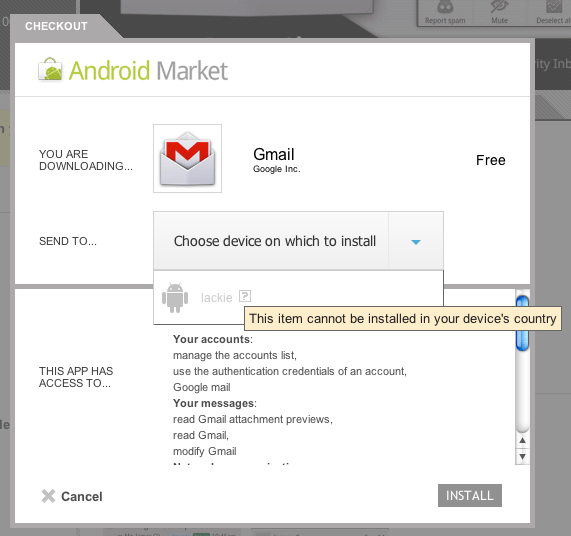
Geo-restirctions for apps in the Android Market is something you won’t hear many people talk about probably because they live in recognized countries where these apps are available. Basically what this means is that when you search for it in the Market app on your Android device, you will not find any results to install. If you use the Android market on the web you get the “This item cannot be installed in your device’s country” message when trying to select your device. This hugely detracts me from trying to recommend Android to users. While I guess many will search for the apk file online and install it, I must stress that this can be a very dangerous thing as it can be malware that you are installing on your device. You must trust your source of applications, if it is not the developer distributing the file, it could be a modified apk installer with malware installed in it.

Some notable apps that are absent from the Market here in Brunei are

As stated in their known issues under “Can’t find app” section, it states the following:

Some users are reporting that they can’t find specific apps on Market. If you can’t find an application, first try editing your search terms; the publisher may have changed the name in the application.
If you’re still experiencing this issue, please make sure that the following conditions do not apply to you:

  • Priced applications availability: Priced apps are only available to buyers in these countries. If you are not in a buyer-supported country, you will be unable to view priced applications.
  • Location: You may only view the version of Market for your country. For example, UK users may only view the UK version of Android Market from their devices. If a developer has not targeted his app to your home country, you may be unable to view it.
  • Mobile service provider: In addition to targeting for location, a developer may also target their application to specific mobile service providers. If a developer is not targeting your mobile service provider, you will not be able to view the application.

From time to time, applications will become unavailable. Publishers might remove their applications from Android Market, or applications may also be removed for policy violations.

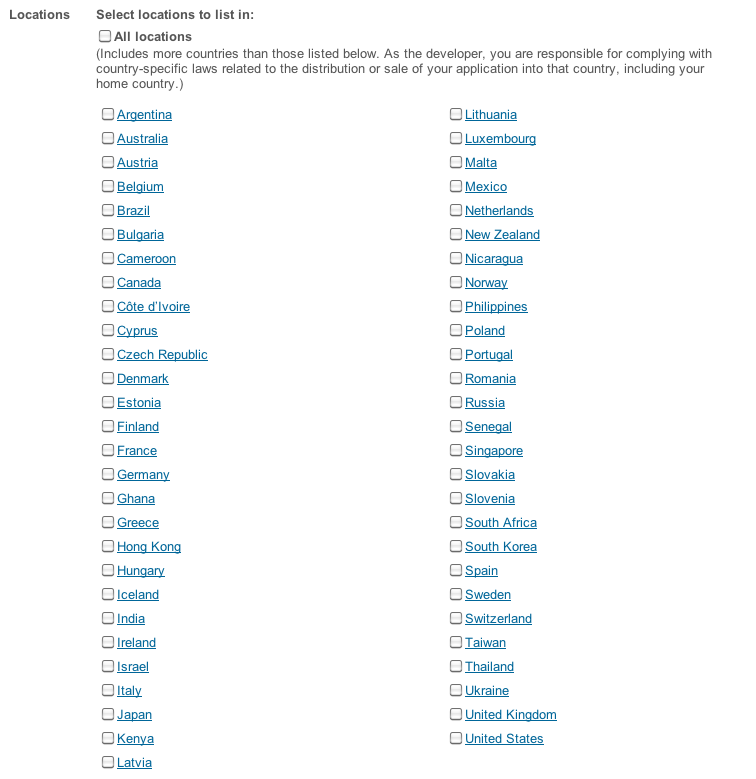
I believe this stems from the following section when developers upload their app into the Market. If the developer does unchecks “All locations” (it is checked by default), the list of countries will be shown and the app will not be available for any country not listed below, i.e. Brunei and others.

What can Google do? They can make Brunei (among other countries) as a supported/recognized country and I presume that would require some business discussions with Brunei banks/mobile carrier/ISP. As a supported country we would probably get access to paid apps as well, but I feel that is unlikely at the moment. Alternatively they can put another check box for “Other Countries” in the listing above so that developers can choose to exclude certain countries but include others.
What developers can do? Where possible make sure “All Locations” is checked, if not host their apk installers on their own site (something that WhatsApp! does)

For an Android fan I feel pretty annoyed about this restriction and is certainly an obstacle as I can’t fully recommend Android devices to people if they have to do ’round-about-things’ such as finding an unofficially distributed apk just to install Skype. Another big issue is with tablets that are able to run Flash but don’t include it out of the box: thus the tablet is neutered to iPad Flash-less status which is sad. I had a Flash apk and installed in on the Acer Iconia A500 but because it wasn’t the latest version it could not run the videos we tested. Also without a recognized country, you can’t even update apps that have been installed previously: we couldn’t update Flash via Market post-install.

There are workarounds as listed below but some aren’t pretty:

Workaround 1: Alternate Store
This is the easiest and I suggest to find a reputable app store such as Opera Mobile Store (I managed to download Skype from here, although it was an older version), but it doesn’t have all the apps I want and thus those need to be sourced from elsewhere. If you know of any other reputable stores that have apps like Skype, do let me know.

Workaround 2: Switch SIMs to a Supported Country
I’ve done this with a Australian Vodafone SIM, and I was able to download Skype. I may even use this to download apks and self-host them for all Android users (as long as I don’t get copyright take downs)

Workaround 3: Root and install Market Enabler
Root your device and install Market Enabler which should allow you to access the apps. I presume this does in software what switching SIMs does in hardware.

Workaround 4: Buy an iPhone / iPod Touch
Yes, I said it. It is a sad but true state of affairs that it is easier on iOS if you register with a US iTunes Account. The hardest thing of registration is is just using the right US address (use Google’s address as there are no taxes in their state according to @mfirdaus). The biggest issue is getting iTune gift cards, something I am still trying to find out for a reasonable price (Places in Brunei that sell them: AV, Incomm & QQeStore). But once that is all setup, it’s all easy sailing.

So Google, I hope you can sort out this problem or Android users will be severely limited in countries that aren’t recognized/supported and would prevent them from recommending Android unless they want to start pirating apps. App developers, please show some love for Android users and host the apks yourself.

Related Links