So previously I had written about “Fixing BruDirect’s Grey Container of Emptiness” but it seems that the workaround of decreasing the font size does not work any longer (doesn’t work in Chromium / Chrome). So the BruDirect problem now has slightly changed: fro grey container of emptiness to the white box of nothingness as shown below.
You can install it in Chromium / Chrome by just clicking the link and installing as a user script (it can be later uninstalled from the Extensions page). Firefox users can use GreaseMonkey to install user scripts.
LG Optimus One's Available Internal Phone Storage of 172MB After a Factory Reset
So after obtaining an Android phone for an extended period of time and exploring Android and the applications, I found what I feel to be one of the biggest hinderance / annoyance / problem with Android: available phone storage. For many people they may think, just adding a large SD card can solve this issue, but this is not the case. All Android phones have RAM and ROM figures in their specifications that are listed on the manufacturer website or websites like GSMArena but the figure may not be accurate for ROM storage.
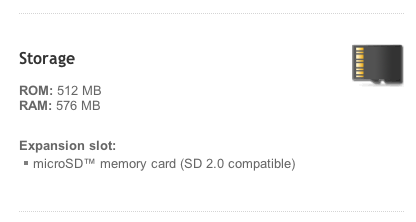
RAM (Random Access Memory) is needed to store temporary application data/information and helps a device multi-task smoothly. ROM (Read Only Memory) is where the phone operating system and applications reside and each device comes with a base set of operating system features and applications that cannot be uninstalled. This will take away some of the available ROM from the user leaving them with less than the figure stated on the official ROM amount. A good example is the HTC Desire which has 512MB ROM according to the specifications page but according to PCMag there is “only 117MB of available internal storage“. 117MB isn’t much and this is the main reason that hinders me from recommending a Desire. It is a very good phone but this is a major issue that can’t be solved.
Android 2.2 helps alleviate this problem by allowing applications to be moved to SD cards however this will only work on applications that support this feature and even if they do, they cannot move the entire application to the SD card; there will always be some part of the application on the internal storage. When you get low storage on your phone things get uglier and the phone may not function properly. I had about 20MB of available phone storage and I tried to add a phone number to an existing contact and was greeted with an “Memory Full: Not enough phone storage space”. I was adding a single 10 digit phone number to a contact and there isn’t enough space to process / store it.
I notice slowness below 25mb free, and around 10/15mb free space, it starts rejecting texts. You’ll get a warning message when your space is too low, use that as a sign that you need to dump your old texts/mms messages, and maybe delete a program or two that you don’t ever use.(Source: Samsung Intercept Forums)
“App data including your call history, contacts, etc. contributes to your phone storage space as well” (Source: Droid Forums.net)
This will lead to Android users to ensure that they have sufficient phone storage and this in turn limits them trying new applications and exploring what Android has to offer. Some people may argue that you don’t need so many applications and that you should delete the apps that aren’t frequently used, but that isn’t solving the problem and if you’re testing out applications you can easily hit the over 200MB (I hit the Optimus One’s ~150MB ‘limit’ of 172MB after installing applications that I wanted to test and a handful of games). I found it very frustrating when I could have a huge SD card with 10+GB free that can’t be fully utilized for applications. It honestly feels like such a waste of space.
I think this is where Android could learn from Windows Phone 7 here where the SD card is fused/combined with the internal storage. This fusing would allow users to upgrade their internal storage at any time allowing users to be in charge of their device. This fusing would also solve the problem of applications not supporting moving to the SD card as the fused SD card would be treated as internal phone memory. This would give the opportunity of the user to upgrade their storage if needed, as opposed to putting the responsibility of the the developer to support moving the application to the SD card as it is now.
Perhaps this is an issue that manufacturers have not decided to take action upon or perhaps they feel that it isn’t a real big issue. Just due to the fact that it hinders exploration of new apps really gets to me. Newer phones come out with larger ROM sizes but how much is available to the users? I checked a friend’s new HTC Desire HD with only a handful of applications install and there was 0.9GB of phone memory still available (specifications of ROM state 1.5GB, thus assume ~1GB available for applications). Will this problem only be for budget phones in the upcoming future? The HTC Desire was by no means a budget phone when it was released (and still isn’t a budget phone) but it has a low amount of internal storage. Could current phones suffer this same problem in the future? Only time will have the answer and in the mean time, this is a big point of contention for me and makes choosing an Android device a bit more challenging. Follow up post on “Things to look out for when buying an Android phone/device” should come soon.
It seems there is no easy surefire way to get the URL’s to play on all platforms. Some players recognize all URLs some recognize only some. The best bet is to try each one I’ve summarized most below:
So I have an Android device as I recently bought an LG-P500 also know as the Optimus One from Incomm’s website for a great deal of B$338. I hadn’t heard much of this phone previous to buying it as it’s not one of the ‘super-phones’ with all the fancy features but albeit it is a great Froyo equipped device (by default) with enough RAM to let it have a fluid interface when using it. First and foremost the details on the Incomm website is wrong: it has a capacitive screen not a resistive screen and it also has multi-touch (and thus has pinch-to-zoom).
lg p500 optimus one with box
lg p500 optimus one unboxed contents
I’ve honestly been looking out for a budget Android phone that will Froyo and this is the closest to my requirements. I can’t justify, to myself, a phone that costs more than B$400, so phones like the HTC Desire are out of the picture. I was slightly interested Huawei U8230 that Bmobile sold recently but it seemed like an end-of-life device with 2.1 being the last firmware update. Other budget Android phones would be:
Another notable device that I didn’t really see or play around with was Samsung Spica (B$388) though at that price, there isn’t much reason not to go for the Optimus One
I wanted a device with an HVGA resolution screen (480×320) as it makes it’s easier for surfing the web without the need to be constantly scrolling through the webpage. That only left the GT540 (the X10’s and Wildfire both have 320×240 screens, and the Galaxy 3 has a 400×240 screen) which has a small 3″ screen with a resistive touch screen. While it was pretty smooth and sensitive when I played with it the small screen made typing pretty hard. The Galaxy 3 has a non-typical screen resolution and while lower than the Optimus One resolution, it is the same physical size at 3.2″ meaning text will look bigger on the Galaxy 3 when compared to the Optimus One.
RAM is more than enough at 512MB to allow smooth(er) multi-tasking and allows for more caching of data if reading large/graphic intensive PDF files. This plays a major part for the overall usability of the device. I can say the Optimus One is pretty snappy and never had an issue of being forced to close/kill tasks. I’ve never needed to use the task manager to close applications in order for the device to be smooth and snappy.
A large 1500mAh battery which seems to have good reviews. I’ve had a pretty good experience last Sunday with 3G on from 7am – 630pm (with no real configuration) but truth be told, I can’t seem to replicate this as of yet, perhaps as I’ve been using it quite a bit or could be some misbehaving apps / syncing issues (an inherent Android problem I believe). Though that being said I crave for Nokia battery life where it wasn’t really an issue to be concerned with.
Other notable features
Custom LG keyboard to enable phone keypad in portrait mode. I actually prefer this, especially coming from a Nokia background and I honestly love the Nokia seems to have single hand use almost perfect. On-screen left and right cursors allow moving the cursor left and right which is good option as the device has no physical / optical trackball for scrolling or text selection.
Froyo: with features such as performance tweaking, being able to move some data application to SD card and tethering via USB/WiFi I consider Froyo as a standard for all Android devices to come with. Lower versions of Android will typically have lower performance and even have application limitations (not having some applications available to install on the device). Make budget phones do not have 2.2 by default.
Accelerometer: so it auto rotates in accordance to the orientation of the device
Some issues / tradeoffs
3.2″ screen: pretty small screen to typing on in portrait mode with the on screen QWERTY keyboard
No trackball/trackpad
No notification light
No auto brightness
No camera flash / forward facing camera
Limited space to install applications: the stock installation only has 170MB of space to install applications. Being able to move applications to the SD card (this will only move some parts of the application to the SD card and it can’t install the ) helps a bit, but this is another annoying Android issue where the device can’t use the entire SD card to install applications and only has a small section of it’s internal storage to install applications.
There is no / little LG customization of Android. They have a slightly customized LG homescreen & application launcher but it isn’t anything like HTC’s Sense, Samsung’s TouchWiz or Sony Ericsson’s Timescape custom user interfaces. These customizations and usability is always a personal preference and you can always install a 3rd party launcher (I’m currently using Launcher Pro)
With about a week using the device and Android, there are more things to be said about them both, and that will come in due time. Have a happy new year everybody!
So as I recently got a new family desktop I was setting things up and had to install Microsoft Office. I bought a copy of Microsoft office earlier this year and thus proceeded to do the activation. I proceeded with the phone activation and spoke my Installation code for verification. It could not recognize the third group of numbers. Very well. Fine. I will just type it in. Same problem! In my frustration I tweeted that this is why people pirate software. Make a legitimate user feel like a prisoner enough times and they will want to run away and pirate.
Installation Code not recognized:
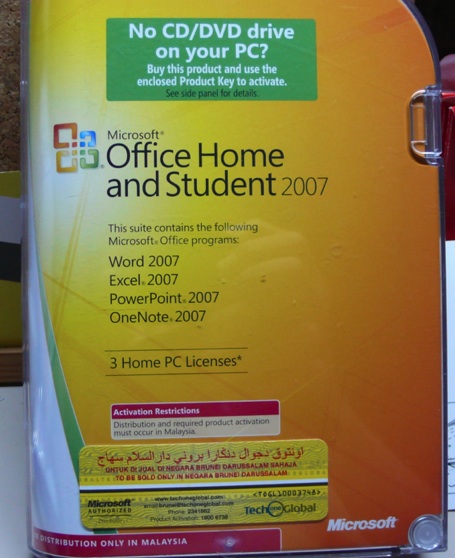
Product in question: Microsoft Office 2007. Note the activation restrictions: “Distribution and required product activation must occur in Malaysia”
Luckily the sorry does not end there with me cursing Microsoft and product activation. On the box it does say that activation must occur in Malaysia. So I Googled for a Malaysian proxy, configured Internet Explorers to user a proxy (Tools > Internet Options > Connections > LAN Settings > Proxy server) and tried online activation and viola! Activated without any other problems.
So during the first week and a half in Australia, while the wife and I were trying to gather things together, we did not have a proper Internet connection. And to make matters worse, the computers that we used to go online did not all have a USB drive to save any screenshots / webpages that we wanted to keep for reference. Thus in order to ‘save’ any information we found online we had to resort to taking photos of the screen. Having them in the dedicated digital camera would be good as it would be able to keep high resolution photos of the information, however it would be a hassle trying to retrieve as we filter out which photo corresponded to which piece of information we would be looking for. So I resorted to my trusty phone, a Nokia E71, to take photos of the screen: not the best quality photos but the functionality that the phone provides, allowed me to gather the information and sort them out properly.
Method of organizing photos on the go on the Nokia E71 (and any older Nokia phones):
Take photo of the information
Rename the photo to a useful name describing the information
Open the file explorer and locate the file
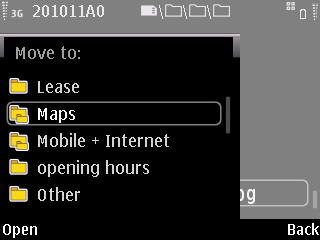
Copy/move the photo to an organized folder layout for easy retrieval (in my case I had an “Australia” folder and I copied maps to the “maps” folder, and house documents to “lease” folder)
This method would work in Android as well since you have access to the fie structure via a file explorer which typically is already installed in the device.There could be a way to do this on iOS, but an application would probably be needed and my efforts of asking around came to nothing (probably time to get an iOS device myself).
What would have been perfect of this situation would be the ability to tag photos. Tagging would allow photos to be categorized in several categories (e.g. a picture of a map of bus routes can be tagged under “map” and “transport” while maintaining a single copy of the file, as opposed to copying the same file into different folders in a file/folder structure). Browsing photos by a tag would allow quick retrieval. I was surprised when I discovered that Symbian (or S60 as most people refer it it as) was the only phone OS to have tagging out of the box: iOS and Android do not have them out of the box. It seems that Symbian has had tagging since the N97 based on this ‘How to Organize Photos on N97 & Mini with Tags” article and thus probably started with Symbian OS 9.3 (as my E71 running 9.2 does not have it). Another side note: the N8 running S^3 also has this tagging feature. I did find that Evernote does support tagging and is available for iOS and Android. It’s meant for organizing data (photos, notes) however it does require an account and Internet connection (when setting it up) and could be a hinderance.
It was the discovery of an Nokia E5 running an old smartphone operating system that made me go back to Nokia’s newest catch phrase of “It’s not technology, it’s what you do with it” because if you talk about buying a smartphone these days it’s basically iOS (in the iPhone) or Android (in many different Android phones). However, neither of these platforms can do tagging out of the box like Symbian can. It is always about what you can do with technology and not just about the hardware/software by itself. Technology should always be an enabler: helping you do to things. It is always great when you can make a device do something it was not able to do before: e.g. magnifying glass for macro photos on fixed focus camera phones or using a blacked piece of film to take photos of a candle (shown to me by @nickthien). So I put forth to all you readers that you take a look at your gadget and see what added functionality you can get out of them. Explore and make full use of your technology. Live long and prosper!
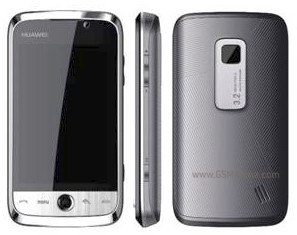
So I just came back from Australia and I found out that B-Mobile was selling the Huawei U8230 at TechXpo 2010 for only BND$299 [Source Borneo Bulletin (Friday 5th November via Website)]. See the full specifications at GSM Arena. The phone was announced in June of 2009 so it is a relatively old hardware platform but at the $299 price point it is very competitively priced. It runs Android 2.1 and uses the same processor is the old HTC Hero so expect it to perform similarly.
Older processor and may not run more modern games smoothly
Not a lot of memory (192MB RAM and 256MB ROM)
RAM is required for multi-tasking so expect to close applications
ROM is used to store applications and since this is not Android 2.2
Possibly no official 2.2 (Froyo) update
I gave B-Mobile a call to see if they have any of the units on display to play around with but alas all the units are sold out and they are waiting for a new batch to come. Not surprising that it is sold out being so cheap and offering so much with Android. I applaud B-Mobile for pushing Android at such an affordable price and, in my phone call with them, they said that it is unlocked too. The phone is not a spectacularly fantastic phone but a solid mid-range phone with great potential with Android. The fact that it is Google certified with the Android Market for downloading applications makes it even more compelling. I would highly recommend this to people wanting to get an affordable smartphone as Android is a currently well supported platform and thus has many up-to-date applications unlike Nokia’s S60.
PS. Anybody in Brunei bought this? I would love to have a hands on.
While stumbling onto the Nokia N8 together with the C7 today (okay this post is almost 2 weeks late due to the fact that I’ve helped my wife relocate to Australia) at Incomm HQ, it got me thinking about the future of phones and computers and got me all that more interested in the Nokia N8. The N8 is B$768 and the C7 is B$638. If you order online through the Incomm website the N8 is just B$730 (thanks GeekInWhite). My interest in the N8 is not just because it is Nokia’s flagship model at the moment, but just the functionality it brings and the possibilities of having a computer in your pocket.
First and foremost the Nokia N8 is a multi-touch capable smartphone with a 12 megapixel camera and Xenon flash. The N8 itself has stand out features that are not really found on any other phone. The camera, which is a focus on many reviews, has proper colour representation (vs the iPhone 4 that does post processing on photos to make them look more colourful) and while also taking relatively good low light shots (thanks to the large image sensor which is even bigger than some digital cameras). Some photo comparisons: DeviceMagazine, Symbian World, Into Mobile, It also shoots 720p video at 25 fps and has a built in video editor and image editor for photos too.
The device is capable to play back 720p content with Dolby Digital Plus Surround Sound via the HDMI out making it a multi-media centre device.There was even mass movie screening of the Prince of Persia on the N8 itself. When connected to an HDMI output the display will be mirrored on both the screen of the N8 as well as the output device (e.g. an HD display). This has possibilities to showcase gaming on the N8 by letting spectators watch exactly what the player sees. However for a regular user, this means it can be connected to a bigger screen and even act as a desktop computer (more on this later).
The N8 also has USB host with USB on-the-go support. This means that you can connect a regular USB drive to it (with the necessary connector cable: micro USB on the N8 to a full USB connector) and transfer files to and from it. What’s more is that you can even attach a keyboard and mouse to the device to make it a productivity device. Most video’s I’ve seen, show mouse and keyboard connected via Bluetooth so I am not sure if you can attach a USB hub and connect all keyboard, mouse and USB drive to the device all at once. However once keyboard and mouse via Bluetooth you will have a setup similar to a real computer as shown in the video below, with a (micro) USB port to be connected to a USB drive to transfer data.
Now the scenario of using the N8 as a full productivity device will also depend on software support: meaning to say that it needs to have applications to allow users to use this is a productivity tool. Software that will let users create and edit documents on the go would be great. According to the specifications the N8 has the feature of “Editing of key office documents” making this possible and what’s more is that with the HDMI output, you can even do presentations powered from your phone (caveat: seems that you need to pay for a ‘pro’ version to edit documents). Productivity is also enabled via the real multi-tasking abilities of the N8 (as opposed to ‘faux’ multi-tasking of the iPhone). Applications run in the background enabling switching from a browser (to search for something) and jumping straight back into your document / tweet that you were composing.
Note that the N8 also uses readily available standards: from micro USB (for data transfer and even charging), to micro HDMI, to a 3.5mm standard jack, a regular micro SD card and a normal sized SIM card. Using these readily available standards, makes it even more interoperatible with your existing devices / cables (as opposed to proprietary connectors like the iPod or even Galaxy Tab).
There are also a couple of technologies that could be built into the phone that I have not heard been mentioned like printing and Bluetooth transfer file transfer/file system browsing support. However I will base this on existing Nokia S60 devices such as the Nokia E71 that I originally typed this post on. The Nokia E71 has abilities to print direct to printers (via Bluetooth / infrared) and allows browsing the filesystem from a host device such as a PC or Mac. What I love about Bluetooth file transfer and filesystem browsing is that you can quickly and easily copy data from the phone wirelessly. Also with HP technology that is getting into printing from the web (i.e. Emailing documents from the phone to the printer to print), it will make things all so much the easier.
I know the device isn’t perfect: for instance in portrait mode you can only type in as a virtual numeric keypad and no QWERTY keyboard. Swype may change that. Also when typing in text, the entire screen is taken up by the text box where you type meaning that if you forget what you’re doing you will have to close or confirm the text input before seeing what you were filling in and going back into the text input screen. I think it was Daniel at Tech65 that mentioned that it seems like a separate application in the way it works and does seem a bit cumbersome especially having to press cancel/back or confirm before continuing.
There is no touch to focus on the device though is something a firmware update could fix but that being said it still at this moment in time does not have it. Also the video recording has no auto-focus and only records at 25 fps. A hack has been demonstrated to enable both but yet again it is not available to all N8 users.
S^3 is also an newly released OS meaning that there are not a lot of applications currently running on it. If application developers do not support it, then users will be at a huge loss compared to iOS or Android users. S^3 can also be considered a convoluted/complicated OS. S60 users would be more accustomed to it but users who like simplicity make be taken a back.
However I think the biggest problem with the N8 is the web browser (TechRadar, Engadget, All About Symbian). I think all Nokia S60 phone users will know that the standard web browser isn’t fantastic and while the browser on S^3 is an improvement, from reviews I’ve read, the browsers still has quite a bit to go to catch up to Safari on iOS and Android browsers. It does play Flash Lite 4.0 which is a nice touch but nothing to write home about.
The N8 software needs real tweaking to make things more usable for the user and for it to make the product really great. But all in all the prospect of the functionality of the N8 makes things one step closer to having a computer in your pocket. Oh yeah it is also a phone with mobile broadband capabilities.
Able to output to a display? Check
Able to connect keyboard and mouse for productivity? Check
Able to copy files to and from USB drives? Check
Able to print to printers? (Probably) Check
What else more do you need from a computer?
So during my travels I found out about prepaid broadband SIM cards that let you have unlimited mobile broadband (e.g. 3G) while on the go. The ones that I’ve used are fromM1 (Singapore) and Digi (Malaysia). I stumbled upon this poster advertising Zoom! (bmobile’s mobile broadband) while visiting Telbru. This is a perfect opportunity for people to test Zoom! to see how well it works in their area: remember it is a shared Internet connection so it can be slow if the area is saturated. Speed also depends on the modem you are using.
Amount
Days of Unlimited Usage
$4
1 day
$8
3 days
$20
9 days
$35
18 days
Note: Just realised my titled was wrong. I forgot to put the word ‘Unlimited’. This is important as DST Go! and bmobile Zoom! already have prepaid options but they are not unlimited. This new unlimited option is a great option for tourist who are here for a short period of time and need not worry about the amount of data they use.
As my wife is looking for accommodation in Australia she showed me an ad that seemed a bit too good to be true: rent was much lower than any other accommodation within the area (suspicion #1). The person insisted that they not go through the real estate website but to email them directly (suspicion #2). On emailing the person in charge the following email was received:
Hello,
First of all I want to thank you for your reply. I really appreciate you took the time to answer me. I am the owner of the apartment located 500/408 Lonsdale Street, Melbourne, Vic 3000. It is still available for rent for $190 p/w including utilities for as long as you need. The apartment is in the best conditions, it is newly furnished and equipped with all the dependencies. I bought the apartment in 2007 and I lived there with my pet until last month when I received a promotion and needed to move to Padova / Italy.
In the apartment you will find a dishwasher, a refrigerator, a freezer, a washing machine, a dryer, an iron, , an oven, a toaster, a coffee maker, vacuum cleaner, a big screen TV, cable TV with the basic access, ADSL internet and Wi-Fi access. Also the apartment is near the public transportation, a shopping mall, a gym, and other facilities. There are no problems if you have any pets, as long as you clean up after them. The apartment has a parking space for one car. I have spent a great amount of money refurnishing the apartment and my request is that you treat it like it was your own. I am not interested to make a lot of money from the rent as I am interested to find a tenant that will take good care of the property until my return(minimum lease period, 3 months).
My contract here in Italy expires in October 2013.
Because I had to move to Italy so soon I didn’t had the time to find a trustworthy agent, I had to take the apartment keys with me. I had a real bad experience with the renting agents from the area with my previous home. I can’t come to show you the apartment and I don’t have any friends in the area to send the keys. I found an alternate solution in order to close the transaction safe for the both of us, it is an international delivery solution called Express Metrix (I will pay for a 2 days delivery),they will provide assistance in handling the payment and delivery of the Keys and Lease Agreement.With this procedure you will be able to check the apartment before I receive the payment.
This is probably a bogus escrow scam and I hope this will help inform people of these scams and to be wary of dealings with people online. While it seems to be Australian focused, a friend mentioned that there is a similar thing in Canada and probably in other countries as well. It’s sad to see people to resort to such tactics but we all need to be vigilant.









 The Wheat Field