Creative Zen V (as a Line-In Recorder) Review

Finally got this review done. Basically I got the Creative Zen V to record sermons at church via direct line-in when connected to a mixer. There are not many line-in recorders these days; Creative had quite a few devices that allow this but they have seem to stopped making them (possibly due to the hiss in the recordings?). Got a good deal at ~B$100 for 2 of them (1GB model, including shipping). Check out the video review

Details of the Creative Zen V

  • Capacity: 1GB / 2GB
  • Audio Support: MP3, WMA, IMA ADPCM, WMA DRM
  • Weight: 43.5g
  • Battery Life: Up to 15 hours for continuous audio playback
  • In-built battery (charges via USB)
  • Voice & Line-In recording supported
  • Line-in recording: 160kb/s, stereo 44.1KHz WMA (66.2MB for 76 min)
  • Microphone recording: 32kb/s, mono, 8KHz WAV (5.9MB for 25.5 min)
  • Monitor recording via
  • Visual level meters
  • Headphone output

Mini-USB connection and connects as an MTP device

  • Windows: no issues
  • Linux: depends on distro but works in recent version of Ubuntu
  • OS X: not supported natively, requires 3rd party application: e.g. XNJB

Main Issues:

  • Buzz/Hiss in line-in recorded audio (check out the video 4:07)
  • Takes relatively long to switch on (~15 seconds)
  • Records to WMA (may need conversion)
  • Possible permanent dimming of screen after extended use (several months)
Windows 7 – Touch Gestures

Ever since the iPhone came out there seems to be a resurgence with touch technology and in particular multi-touch technology. From full all-in-one PC systems like the HP TouchSmart that I’ve seen in Netcom and the MSI WindTop to now the Acer T230H Touch Screen Panel monitor (seen at both Concepts and Netcom). Not knowing what Windows 7 with offered in terms of touch features I looked it up and came across “Using touch gestures” on Microsoft’s Windows 7 microsite (“My favorite ways to use Windows Touch” by John Swenson is also a good read for those considering using a touchscreen)

The main features are:

  • Flicks: basically navigating a page by flicking your finger upwards or downwards as normally seen on iPhones
  • Press and hold: press and holding down on the screen will act as a right click and it will pop-up the context menu
  • Windows Touch Gestures: Pan, Zoom, Rotate, Press and Tap. The first 3 are all similar to Apple’s trackpad multi-touch trackpads gestures but the “Press and Tap” gesture seems new and interesting. In order to activate “Press & Tap” you have to “Press the item with one finger, then quickly tap with another finger, while continuing to press the item with the first finger.”: if you just tap the shortcut menu will appear, if you tap and hold it will be treated as a right click. I’m not sure how well this works in usage and how helpful the shortcut menu is but it is something new and worth exploring
  • The last feature is related to the taskbar: tap the icon in the taskbar and flick upwards and it will show the window menu and jump list

Basically these features aren’t all that great to me, and I feel most of them work on devices with smaller screens and not so much with larger screens. But to all touch enthusiast this should be a good starting point for Windows. Most manufacturers will make their own touch software that runs on top of Windows and provides a more touch friendly experience but they will most likely stick to a multimedia focus or just for goofing around and nothing too productive

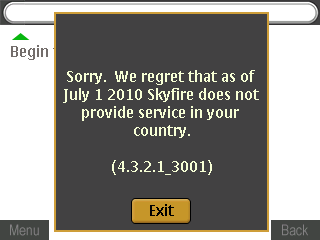
No more Skyfire 1.x for Brunei =(

I read @cloud_stride’s tweet and it is sad to here that SkyFire is limiting their access
to certain countries based on Skyfire version. As a start-up they are focusing their time & money on their new Skyfire 2.0 infrastructure.

Skyfire 1.X will no longer be supported outside of North America and Western Europe effective July 1st, 2010.

Note: Skyfire 1.0 and 1.5 will remain available as a free service in the following countries after July 1st: United States, U.K., Canada, Ireland, Portugal, Spain, France, Germany, Belgium, Italy, Finland, Netherlands, Norway, Sweden, Switzerland, Korea and Taiwan.

So no more being able to watch almost any kind of video format or having ‘full web functionality’ (e.g. Javascript this isn’t supported on the default web browser ala WikiMapia) on my Nokia E71. Skyfire 2.0 for Android and iPhone (in the future) should still be supported though.

SkyFire does not provide service in your country notification
SkyFire does not provide service in your country

iPhone Development – Day 1

So today I thought I’d try to build an iOS application. Managed to cobble something together over lunch with a lot of copy-paste work going on and no reading of the documentation. Not exactly an ideal way to develop but hey I managed to get a functional application that I wanted. Very rough around the edges but functional nonetheless. I wanted to try it out on actual hardware and realized that I had to sign up for the iPhone Developer Program in order to do so. It costs US$99 a year (~BND$140) but thought I would try give it a go especially since I want to develop an application. So I…

  1. Go through the process of logging in
  2. Entered my personal/billing information
  3. Selected the appropriate program
  4. Reviewed my personal/billing information
  5. Did not read the 37 page license agreement (PDF link), but checking the box anyway

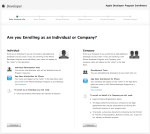
And I get greeted with this:

Apple Online Store is unavailable
Your country either does not have an Apple Online Store or does not offer Apple Developer Products for Online purchase. To complete the purchase of your program, you will need to complete and fax the Purchase Form below

Apple Online Store is Unavailable

Grrrrr. Imagine if I did read that 37 page long license agreement only to be greeted with that. I would have been even more infuriated. Couldn’t they have told me that when I entered my country in my personal details? Or if it depends on current location, they could have done that via my IP. Either way they could have just told me upfront that this is not available for me.

As I won’t be able to get the full experience of the app store approval process I did manage to read this iPhone development story which is a good read and does document some annoyances for developers. While I did not manage to get to the point of transferring any Android application to a physical device I am sure it will not be as difficult as this and I believe it is free as well. But kudos to iOS developers and especially Stack Overflow for having resources that I could just copy and paste and get a functioning application all in a matter of hours without reading the documentation. What happened to policy of developers not being able to tell each other how to program for iOS?

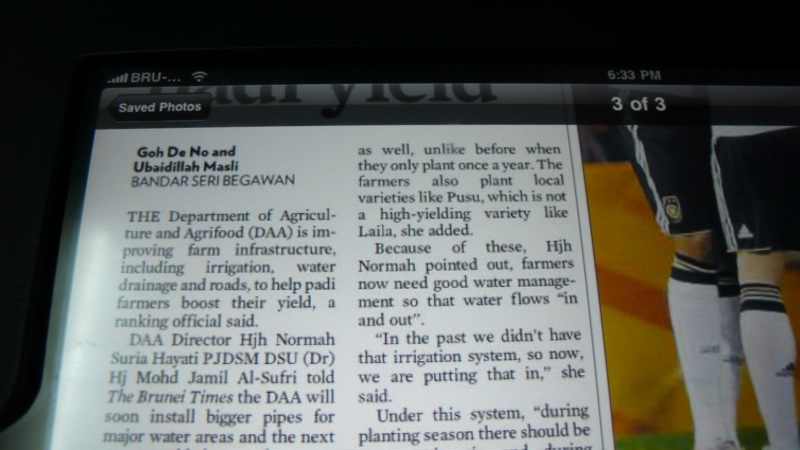
iPad’s Weird Rendering Issue of Images with Text in Safari

So my sister got an iPad and one of the first things I did was to load up my Unofficial Lite Edition of The Brunei Times E-Paper to see how it looked and I was surprised at how bad it rendered the text in the images. It looks fine on my computer and even on a Nokia E71. I wonder why it looked bad on Safari on the iPad. Now if I saved the image and viewed the saved photo in Photos, it turned out fine. Anybody care to explain this to me?

Note: this seems to happen with images that are bigger than the native resolution of the display (or that have to be scaled down in Safari. If I open an smaller image that does not require scaling, the text is fine and clearly visible

Below: Nokia E71 (in Web Browser) and iPad (in Safari) showing the same page (iPad image seems slightly out of focus but close up of the iPad image can be seen in the 2nd photo)

Below: Close up of the page in Safari

Below: As mentioned, if I save the image and open it in Photos it seems fine.

Quick Mac Tip – Search for Menu Commands in Help Menu

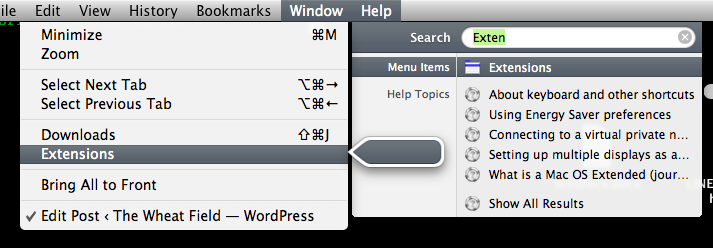
I encountered this cool tip while watching some Mac Break Work. If you can’t remember where to find an exact menu command in program in OS X

  1. Go to the Help Menu
  2. Type word to search for the command. This will populate a list of possible matched commands

  3. Highlight the particular command and click it to execute it or just hover over it and see the ‘magic’. Not only will it open the menu under which the command is listed under but it will also have a little moving pointer that points you to the command

This is great for exploring commands and just finding where a particular command has disappeared to in the menus

Multiple Instances of VLC on OS X

Despite there being an option for Windows version of VLC, it seems to be absent in the OS X implementation of it. In order to run multiple instance of VLC on OS X you will have to open up Terminal and run the following command
/Applications/VLC.app/Contents/MacOS/VLC
Source

This assumes that you installed VLC into the Applications folder. Otherwise you will have change it to the appropriate path where it is installed. It seems that running multiple instances of a program is discouraged by Apple’s usability guidelines (as mentioned by the forum poster) which would be ironic as I believe QuickTime files in Windows all open in a new window / instance as opposed to using an existing one.

YouTube File Formats

One thing I love about Firefox is the Video DownloadHelper. Not only can it be used to download YouTube videos but it can also detect video in any webpage and offer a download link. This is good for situations where you let a YouTube video load only to find that it has stopped loading half way or something messed up. Also having a copy of the file lets you play it while you’re offline too. One thing that has always got me confused was the download links you get on a YouTube page as shown below

There are 2 .flv links and 2 .mp4 links and each file means something different. If you check YouTube’s wikipedia page there are 6 formats in use and as you can see the a high fmt value (which is the number after “HQ” in the download links above) is not necessarily the best quality and also an .mp4 file link is also not necessary the better quality file.

YouTube file formats

Confusing isn’t it? So I downloaded fmt 34,18 and 35 and the following are screen captures from the video of each of them. I did not download 720p or 1080p as I believe those 2 have the highest quality and the 1080p video link did not display in the listing too.

MP4 (fmt 18), resolution: 480×270:

MP4 (fmt 18) blow up to the same resolution (854×480) for comparison:

FLV (fmt 34), resolution 854×480 (am not sure why the resolution is the same as fmt 35 even though the specifications says it shouldn’t be):

FLV (fmt 35), resolution 854×480:

Based on this video it seems that MP4 makes the video blurry and soft while the FLV files (both format 34 and 35) seem hard to differentiate between. Also take note the file sizes:

  • MP4 (fmt 18): 14.5MB
  • FLV (fmt 34): 21.8MB
  • FLV (fmt 35): 30.1MB
  • MP4 (fmt 22): 66.8MB

Taking that into account, I recommending downloaded the MP4 if you are more concerned about file size (and data charges if using 3G to download) while stick with FLV 35 for good quality without huge file sizes of a 720p/1080p MP4 high definition video file.

Motorola Milestone XT launches while the Nokia N8 edits movies

A day after the iPhone 4 was announced with 720p video recording and iMovie for video editing, the Motorola Milestone XT has launched in Singapore with 720p video recording with HDMI out (similar to the Nokia N8) and Nokia also reveals video editing on the N8 (as shown below)

Check out Tech65‘s first look at the Milestone XT below, with pricing with StarHub contracts over at Justin’s blog

I’m personally more interested with Nokia only cause it’s a device with an OS that has yet been released to the public and has features such as USB on-the-go. USB on-the-go allows it to connect to a USB drive for reading and writing purposes just like a regular computer. How cool is that!? Nokia’s timing of releasing footage of movie editing on the N8 has to be a straight punch to iMovie for iPhone 4 and the only issue, specifications wise, for the N8 is the screen resolution of 640×360. Based on Engadget’s smart phone comparison, it’s the 2nd worst of the bunch just after the Palm Pre. However, I still believe in Nokia as it has features like file management via bluetooth, meaning I can transfer files to and from the phone wirelessly. While it may not be as fast as USB, the convenience factor trumps it and I use it all the time with my Nokia E71. Specifications-wise the N8 is similar to the iPhone 4 but being a new OS there could be issues, but I’m hoping that Nokia will use it’s many years of phone making experience to add that extra touch to their new product that could give iOS and Android a run for their money